Key Takeaways
- Of the four mainstream cat litter types on the 2026 market, only tofu, wood pellet, and plant-based formulas meet the strict definition of environmentally friendly cat litter — bentonite clay does not biodegrade and is mined, not grown.
- Tofu cat litter is currently the strongest match for environmentally friendly positioning: 100 % soybean residue, biodegradable in 4–6 weeks in soil, flushable in small quantities, and light to ship.
- Wood pellet cat litter ranks second on eco-credentials — renewable softwood by-product, low-dust, flushable in many jurisdictions — but the pine resin smell is a deal-breaker for some cats and households.
- Plant-based cat litter (cassava, corn, paper, wheat) is the smallest-volume eco category in 2026 but offers the widest range of textures and is the safest pick for sensitive, allergy-prone, or kitten households.
- Bentonite cat litter remains the global volume leader (~60 % market share by retail value) because of clumping strength and price — when an environmentally friendly formula is not yet available, low-dust bentonite with proper waste handling is the pragmatic choice.
- PY-PET, the wholesale private-label arm of Puyuan Dalian Pet Products Co., Ltd, ships all four formula families from one Dalian factory (since 2000, 300,000+ tons/year capacity, BSCI / ISO 9001 / SGS certified) at 1×20 GP MOQ to 80+ countries.
- If you want one rule of thumb: for a single-cat, urban, indoor household, switch to tofu or plant-based; for a multi-cat home that needs clumping strength, choose low-dust bentonite and offset disposal impact with proper bagging.
What Makes Cat Litter “Environmentally Friendly”?
Three independent criteria decide whether a cat litter earns the environmentally friendly label: source material, end-of-life behaviour, and manufacturing footprint. The first two are easy for a buyer to verify — the third requires a look at the supplier. PY-PET uses the same three-criteria lens internally before adding any formula to its product page, and the same lens applies here.
Source material — grown, not mined
Environmentally friendly cat litter starts with raw material that is renewable on a human timescale. Tofu litter is made from soybean residue — a by-product of tofu and soymilk manufacturing that would otherwise go to feed or landfill. Wood pellet litter is made from softwood sawdust, often pine or spruce, pressed into pellets without chemical binders. Plant-based litters use cassava starch, corn, wheat fibre, or recycled paper. Bentonite clay is the outlier: it is strip-mined in a small number of countries (chiefly the United States, China, and Turkey) and is a finite resource, not a renewable one.
End-of-life behaviour — biodegrades, not persists
A cat litter that breaks down in soil or municipal compost within weeks to months is, by industry convention, biodegradable. Tofu, wood, paper, cassava, corn, and wheat litters all meet this bar. Bentonite clumping litter does not biodegrade — once used, it persists in landfill for decades and expands when wet, which complicates disposal. Silica gel litter is also non-biodegradable, though it is non-toxic and chemically inert. If end-of-life is your deciding criterion, choose a plant-based or wood-based formula.
Manufacturing footprint — certified and audited
Even a biodegradable formula has an environmental cost in production. Look for the supplier-side certifications that signal an audited factory: BSCI for social compliance, ISO 9001 for quality management, ISO 14001 for environmental management, and per-batch third-party testing through SGS.
These certifications are not a guarantee of zero impact, but they do mean the factory has external eyes on waste, water, energy, dust, and worker conditions. PY-PET’s Dalian factory holds amfori BSCI social-compliance certification, ISO 9001 quality management, and SGS third-party lab coverage, and runs at 300,000+ tons/year on a single line.
The 4 Main Litter Types Compared (B2C + B2B Buyers)
The four cat litter types below cover more than 95 % of the global retail and wholesale market in 2026. The table compares each on raw material, biodegradability, flushability, clumping, dust level, and the buyer profile each formula fits best.
| Formula | Main Material | Biodegradable | Flushable | Clumping | Dust Level | Best For |
| Tofu cat litter | 100 % soybean residue | Yes (4–6 weeks) | Yes (small qty) | Moderate | Low (<0.1 %) | Urban single-cat, eco-led households |
| Wood pellet litter | Pine / softwood sawdust | Yes (8–12 weeks) | Often (small qty) | Loose pellets | Low | Multi-cat, septic systems |
| Plant-based litter | Cassava, corn, wheat, paper | Yes (4–12 weeks) | Sometimes | Varies | Low to medium | Kittens, sensitive / allergy homes |
| Bentonite clay litter | Sodium bentonite (mined) | No (decades) | No | Strong (≤3 s) | Medium to high | Multi-cat, clumping-priority homes |
| Silica gel litter | Silica crystals (synthetic) | No | No | None | Very low dust | Single-cat long-interval owners |
Tofu Cat Litter — The Closest Thing to Truly Green
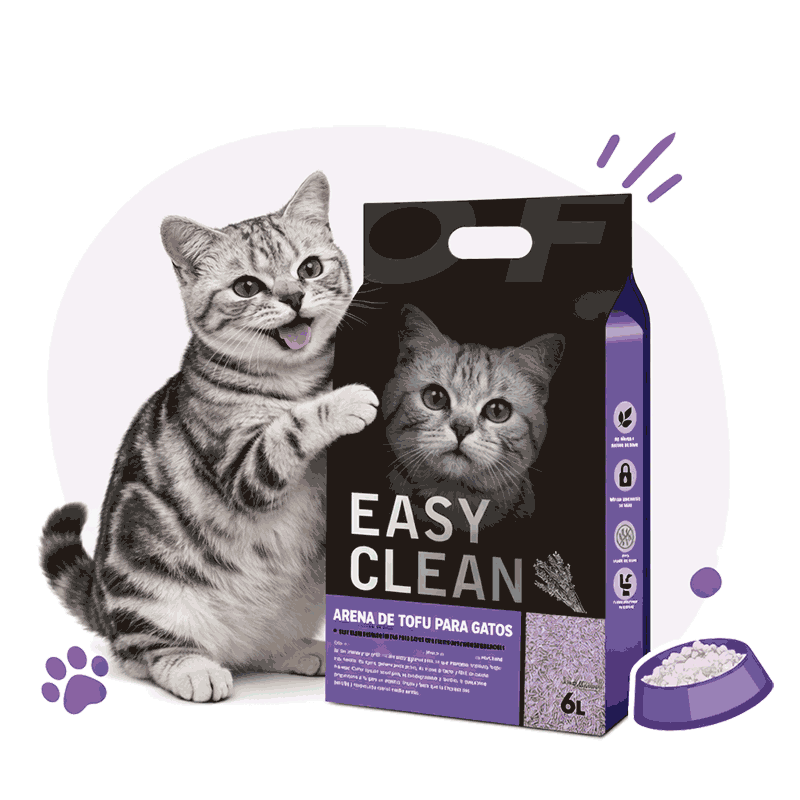
Tofu cat litter is made from the soybean residue left over from tofu, soymilk, and soybean oil production. The residue is dried, ground, and pressed into 1.6–2.5 mm cylindrical pellets, sometimes with a light charcoal or green-tea additive for odour control. Because the raw material is a food-industry by-product, the litter is renewable by definition and breaks down in soil in roughly 4–6 weeks under typical compost conditions.
Composition, clumping, and dust
Tofu pellets swell on contact with moisture and form soft-to-firm clumps within a few seconds. The clumping strength is not as rock-hard as premium sodium bentonite, but it is more than enough for daily scooping in a single-cat or two-cat home. Dust on pour is well below bentonite — typically under 0.1 % measured at 200-mesh — which makes tofu a strong pick for asthmatic cats and humans.
Flushability, biodegradability, and end-of-life
Pure, additive-free tofu litter is flushable in small quantities through standard residential plumbing, in line with industrial-compostability benchmarks such as the BS EN 13432 standard. Always check local council rules first — some wastewater authorities prohibit flushing any animal litter regardless of formulation. For off-sewer homes, used tofu litter can go into a dedicated pet-waste compost bin or a municipal green-waste programme where pet waste is accepted.
Where to buy and what to expect
Retail 6 L bags run USD 12–20 in most markets; the same formula at wholesale lands in the USD 1.20–1.80 per kg range on a 1×20 GP container. PY-PET’s tofu cat litter wholesale line ships the four standard aroma profiles (Original, Green Tea, Lavender, Charcoal) with 18 MT per 20 GP, MOQ one container, lead time within 20 days from payment, FOB Dalian. PY-PET’s broader eco range covers tofu, cassava, and corn blends for buyers who want a single supplier across all eco-formulas.
Wood Pellet Cat Litter — Renewable but With Caveats
Wood pellet cat litter is made from softwood sawdust — usually pine, sometimes spruce or fir — compressed into 6–8 mm pellets at high pressure with no chemical binder. The pellets break down into fine sawdust when wet, which the cat buries under the next layer of pellets. Because the raw material is a forestry by-product, the formula scores well on renewability.
Composition, clumping, and dust
Wood pellets do not clump in the conventional sense — instead, the saturated pellets turn to sawdust at the bottom of the box, which makes daily scooping a sifting job rather than a clump-removal job. Many owners like this because the box stays cleaner between full changes. Dust is low if the pellets are kiln-dried properly; poor-quality pellets shed fine sawdust on pour. The pine resin smell is unmistakable and is the most common reason a cat rejects the formula — about 10–15 % of cats in published surveys actively avoid pine-scented boxes.
Flushability, biodegradability, and end-of-life
Wood pellet litter is biodegradable in 8–12 weeks under typical compost conditions and is often approved for flushing in small quantities through standard plumbing. Composting works well for the litter itself; cat faeces and any soiled material should not go into a vegetable-garden compost because of Toxoplasma risk.
Used wood pellet litter can also work as a soil conditioner around ornamental shrubs once composted. If pine sensitivity is a concern, look for heat-treated or “low-VOC” pellet variants.
Where to buy and what to expect
Retail 8–18 kg bags run USD 18–35 depending on region; wholesale lands around USD 0.60–1.00 per kg. PY-PET ships kiln-dried pine pellets on the same Dalian production base, at 22–25 MT per 40 ft HC bulk container, with the same 1×20 GP MOQ and FOB Dalian terms as the tofu line.
Plant-Based Cat Litter — Cassava, Corn, Paper, Wheat
Plant-based cat litter is the smallest of the four main categories by volume but the widest in formulation. The umbrella covers four distinct raw material families, each with its own texture and behaviour.
Cassava cat litter
Cassava starch is pressed into light pellets with similar clumping behaviour to tofu. The raw material is a tropical root crop, so the supply is geographically concentrated in Southeast Asia and West Africa. Clumping strength is moderate; biodegradability is fast at 4–6 weeks. The category is gaining share in equatorial retail markets where local sourcing is a brand story.
Corn and wheat cat litter
Corn and wheat litters are usually fine-ground kernels that clump on contact. Clumping is solid but tends to track more than tofu, and dust is moderate unless the formula has been sieved. These litters are popular in North American retail and are also used in some European private-label SKUs. Cats with grain allergies sometimes react, so monitor new-introduction closely.
Paper cat litter
Recycled-paper litter comes in pellet or shredded form. It is non-clumping, very low-dust, and is the gentlest of the four on kitten paws. Paper is the safest pick for post-surgical cats, declawed cats (where still legal), and any cat with a paw injury. Biodegradability is excellent but the litter itself is not flushable in most jurisdictions.
Where to buy and what to expect
Plant-based formulas are usually sold in 5–10 L retail packs or 25 kg bulk bags. Wholesale pricing varies widely by raw material: paper is the cheapest, cassava and corn are in the middle, wheat-fibre blends sit at the top. PY-PET ships cassava, corn, and paper variants on a single Dalian production line, with 18 MT per 20 GP and FOB Dalian standard.
Bentonite & Mineral Cat Litter — Performance Wins, Sustainability Trade-offs
Bentonite cat litter is the global volume leader and the formula most cats in most homes have used for the past 30 years. It is a sodium-bentonite clay mined from a small number of deposits worldwide; on contact with moisture it expands and hardens into a tight clump that is easy to scoop. The performance benefits — clumping strength, odour control, low-cost-per-use — are real, and the environmental trade-offs are equally real.
Why bentonite still wins in 2026
Three reasons. First, clumping strength: sodium bentonite locks moisture inside a solid clump in 2–3 seconds, which keeps the rest of the box dry and lowers ammonia build-up. Second, price: at USD 0.30–0.60 per kg at retail, it is roughly half the per-use cost of tofu or wood. Third, familiarity: most cats transition to bentonite without resistance, and most owners know how to maintain a bentonite box. For multi-cat homes where clumping convenience dominates the buying decision, bentonite is still the rational default.
The sustainability trade-offs — and how to manage them
Bentonite is mined, not grown. The environmental cost of bentonite cat litter is therefore concentrated in three places: mining footprint, transportation footprint (it is heavy to ship), and landfill persistence after use. None of these costs can be eliminated — but two of them can be mitigated. Mining impact shrinks when the supplier runs an audited ISO 14001 environmental management programme; transportation footprint shrinks when the formula is sourced from a factory close to the destination market (PY-PET ships Dalian-to-port in standard containers); landfill persistence shrinks when used litter is bagged and disposed through responsible household waste channels rather than flushed or scattered.
Where to buy and what to expect
Retail 5–25 kg bags cover the full price band; wholesale pricing lands around USD 0.20–0.40 per kg on a 20 GP container. PY-PET’s bentonite line is sourced from Wyoming-grade sodium bentonite, low-dust sieved to <0.1 % at 200-mesh, with 18 MT per 20 GP and a 25 L retail carton option. For buyers who need the same clumping strength with a smaller environmental footprint, PY-PET blends bentonite with plant-based carriers to cut the mined-clay fraction by 30–50 %.
How to Choose the Right Environmentally Friendly Option for Your Cat
There is no single best environmentally friendly cat litter for every household — the right choice depends on your cat, your plumbing, your garden, and your budget. The four questions below cover the 90 % of decisions; everything else is preference.
1. How many cats do you have, and how much clumping do you need?
One cat in a small urban flat can be served by tofu, wood, or plant-based — clumping convenience matters less because the box is small and easy to change often. Multi-cat households that need clumping strength to keep the box dry between changes usually end up with bentonite or a tofu-bentonite blend. If clumping is the deciding factor, choose a formula that locks moisture within 5 seconds.
2. What does your plumbing and waste system support?
If you are on municipal sewer, flushable tofu or wood pellet litter saves you a weekly trip to the outdoor bin. If you are on septic, never flush any cat litter — tofu and wood are still the safest pick for composting. If you have no garden and rely on municipal waste collection, bag the used litter in a sealed compostable bag and put it in the household rubbish. Local rules always win: check your council or municipality before assuming any disposal path — packaging waste falls under frameworks such as the EU Packaging and Packaging Waste Directive 94/62/EC in EU markets.
3. Does your cat have any sensitivities?
Cats with respiratory or paw sensitivities do best on low-dust tofu or paper formulas. Cats with grain sensitivities should avoid corn and wheat litters. Cats that reject pine scent need a non-wood formula. Kittens and senior cats do well on paper or fine-ground tofu pellets because the granule size is gentle on small paws. Trial a 5–10 L retail bag for one week before committing to a full 18 MT container.
4. What is your per-month budget at retail vs. wholesale?
At retail, a single-cat household spends USD 18–35 per month on most cat litter formulas. At wholesale via a private-label or bulk order, the same volume drops to USD 6–12 per month. For pet-store and e-commerce retailers, the margin opportunity is even larger: retail markups of 30–60 % over wholesale are standard in the 2026 cat litter category across all four formula types.
Frequently Asked Questions
Seven common questions about environmentally friendly cat litter, with answers grounded in the 2026 retail and wholesale market. Where a question touches a regulation or a standard, the linked source appears inline so you can verify the claim yourself.
Q1. What is cat litter made of?
Most cat litter is made from one of four raw material families. Clumping clay litters use sodium bentonite, a natural volcanic clay that swells and hardens on contact with moisture. Tofu cat litter uses compressed soybean residue from food manufacturing. Wood pellet litter is made from softwood sawdust, often pine, pressed into pellets without chemical binders. Plant-based and paper litters use recycled paper, cassava starch, corn, or wheat fibre. Each raw material has a different environmental profile — bentonite is mined and not biodegradable, while tofu and wood pellets are made from agricultural or forestry by-products and break down in soil.
Q2. Is cat litter biodegradable?
Only some cat litter is biodegradable. Tofu, wood pellet, paper, cassava, corn, and wheat litters all break down in soil within a few weeks to a few months under typical composting conditions. Bentonite clay litter, on the other hand, does not biodegrade — once mined and used, it persists in landfill for decades. Silica gel litter is also non-biodegradable, though it is non-toxic and can sometimes be landfilled safely. If biodegradability is the deciding factor, choose a plant-based or wood-based formula and avoid clumping clay.
Q3. Can you flush cat litter?
You can flush some cat litter, but most you should not. Tofu litter and certain certified wood pellet litters are designed to be flushable in small quantities through standard residential plumbing. Bentonite clumping litter should never be flushed — clumps swell inside pipes and cause blockages, and bentonite solidifies in sewer lines. Even with flushable formulas, only flush the litter itself, not clumps with faeces, and only flush a small amount at a time with plenty of water. Local wastewater rules may forbid flushing cat litter entirely, so check first.
Q4. Is cat litter compostable?
Some cat litter is compostable, but with important caveats. Pure tofu litter, wood pellets, paper, and other plant-based formulas will compost in a well-managed home or municipal compost pile within 4–12 weeks. Cat faeces and any clumped material should never go into a compost bin used for edible gardens — cat faeces can carry Toxoplasma gondii, which is harmful to humans and other animals. Use composted litter only on ornamental gardens, not vegetables or food crops.
Q5. How often should you change cat litter?
Clumping litter should have solid clumps scooped out daily, with a full box change and wash every 2–4 weeks. Non-clumping or plant-based litter that does not form solid clumps typically needs a full change every 2–3 days for a single-cat household, or every 1–2 days in multi-cat homes. Always follow the manufacturer’s guidelines on the bag, and replace sooner if strong odours persist even after scooping. Wash the empty box with mild soap and water before refilling.
Q6. How do you dispose of cat litter responsibly?
Bag used clumping or clay litter in a sealed compostable or plastic bag and put it in the household rubbish — never down the drain or into a vegetable-garden compost. Tofu and plant-based litter can be composted in a dedicated pet-waste compost bin for non-edible gardens, in line with local council rules. Wood pellet litter can sometimes be composted or used as mulch around ornamental shrubs. Always check local regulations, as some municipalities ban litter disposal in food-compost or yard-waste programmes.
Q7. Why is cat litter so expensive?
Three things drive cat litter pricing. First, raw material cost: sodium bentonite is cheap per kilogram, while food-grade soybean residue and FSC-certified softwood pellets cost more to source and process. Second, processing and dust-removal: low-dust formulas go through extra dedusting and sieving stages that add factory cost. Third, certification and testing: BSCI social-compliance audits, ISO 9001 quality management, and per-batch SGS lab reports for dust, clumping, and odour all add unit cost. Wholesale buyers can compress the per-kilo price significantly — PY-PET’s 18 MT per 20 GP bulk lane lands tofu and bentonite litter at a fraction of retail-shelf price.
Where PY-PET Fits In
PY-PET is the customer-facing wholesale brand of Puyuan Dalian Pet Products Co., Ltd, a Dalian-based pet litter manufacturer operating since 2000 with 300,000+ tons/year capacity across four formula families — tofu, wood pellet, plant-based, and bentonite. The factory runs to BSCI social-compliance, ISO 9001 quality management, and SGS third-party lab coverage, and ships to 80+ countries at 1×20 GP MOQ, FOB Dalian standard (EXW / CIF / DDP quoted per lane on request).
For retailers, distributors, and private-label brands evaluating environmentally friendly cat litter at scale, the PY-PET wholesale line consolidates tofu, wood pellet, plant-based, and bentonite on a single Dalian production base with per-batch dust, clumping, and odour lab reports included with every shipment. For individual cat owners who want to read more before buying, PY-PET’s biodegradable cat litter guide covers the most common eco-formula question in detail. To request a sample pack, a per-batch lab report, or a wholesale quote, contact the PY-PET team with your destination port, monthly volume, and any artwork requirements for private-label SKUs.