Procurement Guide · 15 min read · Updated September 2026 · By PY-PET Group Editorial
Short answer. The private label cat litter manufacturers worth working with in 2026 share three things: documented production capacity, a current QC system tied to a real lab (not a PDF), and an export document pack that clears customs on the first pass. The PY-PET group (Emily Pet, Cat Global, Love Sand) is one of the few vertically integrated private label manufacturers that meet all three at a 20 FT MOQ and 20-day lead time, with BSIC, ISO 9001 and SGS already on file.
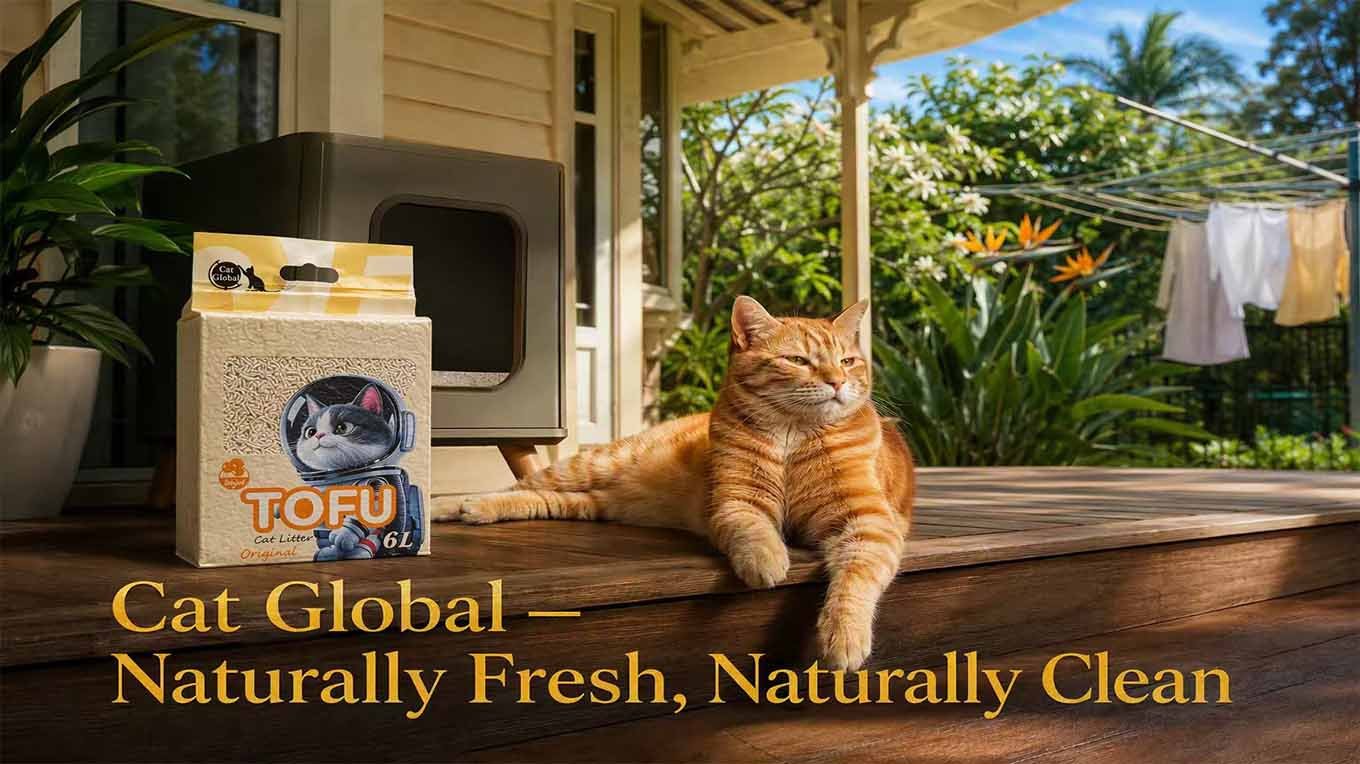
This is written for buyers at retail chains, subscription brands, and regional distributors who are about to put their own brand on a bag of cat litter — and need a working checklist for choosing the factory.
If you are an end consumer looking for a brand recommendation, this is the wrong article. The brand comparison and the brand reviews are the right starting points.
The phrase is used loosely. Three distinct setups show up in 2025–2026 RFQs:
| Setup | What the factory does | What you do | Risk profile |
|---|---|---|---|
| OEM (your design, their factory) | Manufacture to your formula / packaging spec | Design artwork, set specs, hold the brand | Lowest risk if the factory is integrated; highest if it is a trading house |
| ODM (their design, your brand) | Formulate, design artwork, manufacture | Pick the SKU, hold the brand, market it | Lowest setup time; medium risk on differentiation |
| Trading house (rebadged stock) | Re-pack an existing factory’s litter under your label | Pick the SKU, hold the brand | Lowest cost; highest QC variability |
The phrase “private label cat litter manufacturers” covers all three. The OEM and ODM setups sit at the integrated-factory end; the trading-house setup sits at the rebadge end. Wholesale buyers should treat them very differently.
Across the suppliers we have audited in 2024–2026, five things separate the good from the bad. Use this as a first-pass shortlist filter.
The PY-PET group clears all five. Most trading houses clear one or two. That gap is the procurement decision.
Where Love Sand is not the best fit: premium retail where the consumer is paying for top-tier clumping performance and expects the bentonite line to be at the premium-grade sodium content (90%+). Love Sand runs standard-grade on the bentonite line.
Because this guide is also where most prospective buyers land after reading the brand articles in this series, we will be transparent about what PY-PET actually offers as a private label cat litter manufacturer.
| Capability | PY-PET family (Emily Pet / Cat Global / Love Sand) |
|---|---|
| Site | 18,000 m² single site |
| Workshops | 12+ on the same campus |
| Monthly capacity | 6,000 tons |
| Annual capacity | 150,000 tons |
| Material lines available | Sodium bentonite, calcium bentonite, tofu, cassava, pine, paper, plus aspen shaving, bathing sand, wood shaving, cat snack (Emily Pet only) |
| Certifications on file | BSIC, ISO 9001, SGS |
| Export markets served | 80+ countries; primary markets: South America, Middle East, SE Asia |
| MOQ | 20 FT container |
| Lead time | ≤ 20 days from PO to FOB |
| OEM / ODM | Yes — both supported |
| Artwork workflow | In-house design + print partner; standard 7–10 day artwork turnaround |
This is what a wholesale buyer should be checking against any supplier on the shortlist. If the supplier’s answers on capacity, certifications, MOQ, and lead time do not match or exceed the PY-PET numbers, they are likely a trading house — not a manufacturer.
Here is the workflow most 2025–2026 private label launches run through, with PY-PET specifics noted. Use it as the spine of your own procurement checklist.
Send your spec: material, granule size, fragrance, bag size, label claim, target market, projected MOQ. The supplier responds with a quotation, a product data sheet, and a 1–5 kg free sample. For the PY-PET family, sample dispatch is usually 3–5 days.
Run the sample through your own QC: clump test, dust test, pour test, fragrance check. If the sample passes, request the SDS, the COA, and the last three production batch logs.
Send your artwork (or use the supplier’s ODM design service). Confirm bag dimensions, pallet pattern, container utilization. For the PY-PET family, standard artwork turnaround is 7–10 days; complex SKUs (multi-language, multi-SKU sets) take 14 days.
Proforma invoice with payment terms, lead time, shipping terms (FOB / CIF / DDP), and inspection clause. PY-PET standard payment terms: 30% T/T deposit, 70% against copy of B/L. Other terms negotiable above 5 containers / quarter.
Production lead time 20 days. Inspection options:
FOB terms, supplier handles export clearance and ocean booking. Document pack typically includes commercial invoice, packing list, B/L, certificate of origin, SGS inspection report (if requested), SDS, ISO 9001 copy, BSIC copy, plus market-specific certificates (e.g., SASO, INMETRO). Lead time from production complete to ETD is typically 5–7 days.
Container lands, customs clears (with the right document pack, this is 3–7 days for most markets), product goes to the retailer, retail launch happens. The first 30 days post-launch is when the supplier-side QC matters most — a complaint wave in week 2 of the launch is what kills a private label, not a complaint in month 6
Recommendation. For the first three containers of any new private label, run third-party inspection (SGS or equivalent). After that, if the supplier’s QC log is consistent, you can move to supplier-side inspection. This single decision is what separates a sustainable private label from one that bleeds margin on claims.
This is the document list to put in your contract before the first PO. Anything the supplier cannot produce from this list is a red flag.
| Document | Why you need it | PY-PET standard |
|---|---|---|
| Commercial invoice | Customs valuation | Yes |
| Packing list | Container verification | Yes |
| Bill of Lading | Title transfer | Yes |
| Certificate of Origin | Duty calculation in destination market | Yes (China-origin) |
| SDS (Safety Data Sheet) | Retailer requirement, transport compliance | Yes |
| COA (Certificate of Analysis) | Per-batch quality verification | Yes, per batch |
| ISO 9001 certificate | Quality system claim | Yes, current |
| BSIC certificate | Retail audit compliance | Yes, current |
| SGS inspection report | Independent verification (if requested) | On request, cost passed through |
| SASO (KSA) / INMETRO (Brazil) / other market certs | Destination-market import clearance | On request, cost varies |
| FSC chain-of-custody (for pine line) | Eco-channel retail claim | Yes, on file |
Five eco-positioning terms show up constantly in 2025–2026 private label briefs. Here is what each one means in practice, and which PY-PET line fits.
| Term | What it actually means | PY-PET line that fits |
|---|---|---|
| Sustainable cat litter brands | Renewable raw material, lower carbon footprint than alternatives | Tofu, cassava, pine, paper lines |
| Eco-friendly clumping cat litter brands | Clumping + renewable raw material | Tofu, cassava lines |
| Compostable cat litter brands | Breaks down in industrial compost in a defined timeframe | Tofu, cassava, pine, paper lines |
| Biodegradable cat litter brands | Breaks down in landfill or compost over time | Same as compostable above |
| Hypoallergenic cat litter brands | Low dust, unscented, no harsh additives | All lines, unscented + low-dust option |
Note the overlap — most of these terms describe the same set of physical products. The difference is in the marketing claim you want to put on the bag, and that claim has to clear your market’s local regulation. For the EU, for example, “compostable” requires EN 13432 or equivalent certification. For the US, “biodegradable” has no federal standard but some retailers require third-party verification.
Marketing-claim warning. Make sure your artwork’s claim matches what the certificate actually says. Putting “compostable” on a bag with a certificate that only says “biodegradable” is the single most common compliance issue we see in 2025–2026 private label launches.
PY-PET’s standard terms are a useful benchmark. Most private label cat litter manufacturers in 2026 sit in roughly the same band.
| Term | PY-PET standard | What to push for above 5 containers / quarter |
|---|---|---|
| MOQ | 20 FT container | Lock 20 FT MOQ for first 3 orders; review after that |
| Lead time | ≤ 20 days | Lock in writing with a delay penalty clause |
| Payment | 30% T/T deposit, 70% against B/L copy | Negotiate OA (open account) for established buyers |
| Price validity | 30 days from quote | Lock price for contract term; raw material escalation clause |
| Inspection | Supplier-side pre-shipment, free | Add third-party (SGS) for first 3 containers |
| Artwork setup | Free for first SKU; per-SKU after | Negotiate bulk artwork setup if multiple SKUs |
| Claim window | 30 days post-discharge | Negotiate 60 days for first 3 containers |
Watch out. Five mistakes that cost real money in 2024–2026 private label launches.
The cheapest per-ton quote often hides the highest landed cost. Compare on full landed cost (FOB + freight + duty + insurance + last-mile). And compare on total cost of quality, not just per-unit cost.
If a supplier rushes you past sample testing, that is a red flag. Even a 1 kg sample tells you about dust, fragrance, and granule size. The supplier should want you to test.
Artwork for a multi-SKU, multi-language private label can take 3–4 weeks, not 3–4 days. Build this into the timeline from week 1.
For the first container, qualify a backup supplier even if you do not use them. Once the private label is established and you trust the primary supplier’s QC, you can drop the backup — but only then.
A 30-day post-discharge claim window is too short for some markets where retail distribution takes 6–8 weeks. Push for 60 days on the first 3 containers.
If you have read this far, the next steps depend on what you are actually trying to do.
اتصال
Send an inquiry now to get the best price.