Sustainability Guide · 10 min read · Updated September 2026 · By PY-PET Group Editorial
healthy cat litter brands
safety
unscented
natural
Short answer. The healthiest cat litter brands are not defined by a single test. They are defined by a stack of four attributes: low dust, no heavy-metal residues, no or low fragrance, and transparent raw material origin. The safe cat litter brands worth carrying for wholesale buyers are the ones that publish lab reports for each attribute, not the ones that print “natural” on the bag. Unscented cat litter brands are the safest by default, but they still have to control odor through the formula, not by masking.
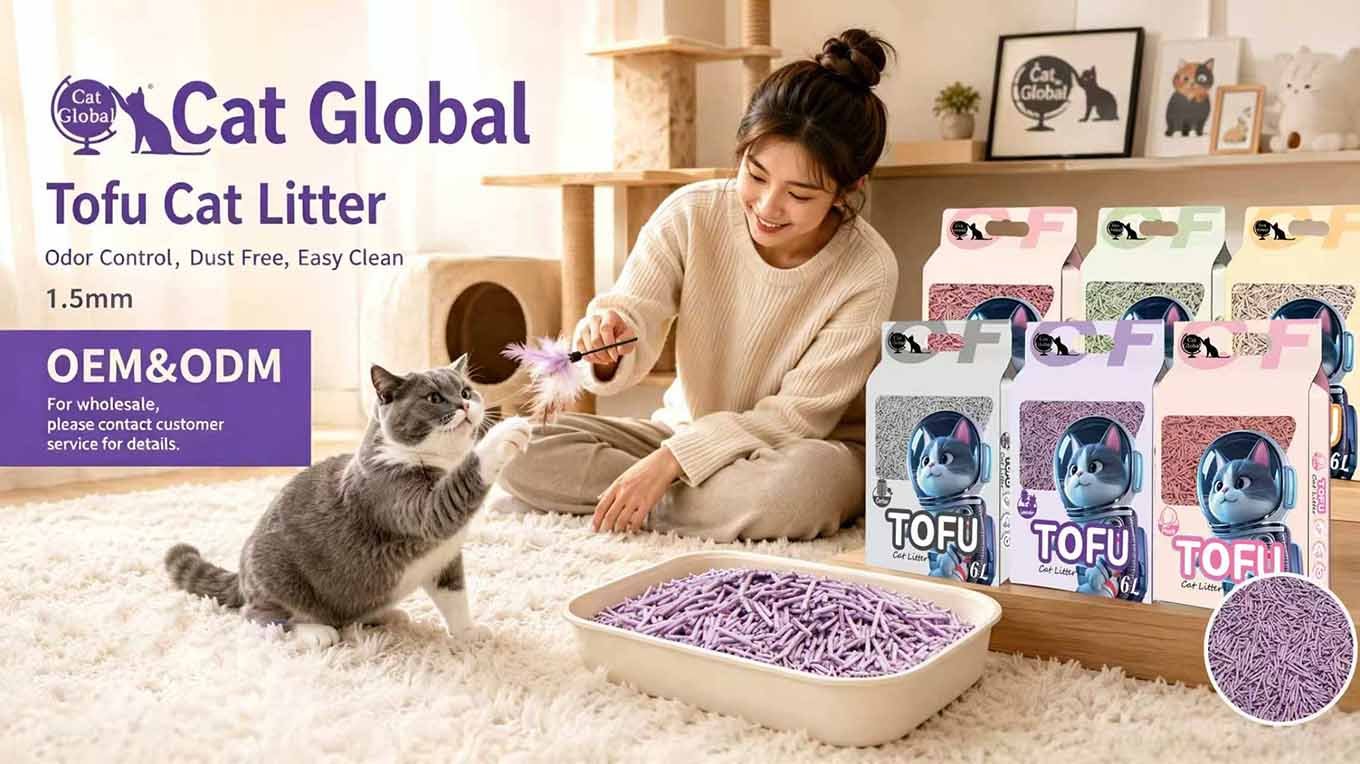
The healthiest cat litter brands are not defined by a single test. They are defined by a stack of four attributes that any responsible supplier should be able to demonstrate in writing.
Dust is the single biggest respiratory risk from cat litter — for the cat and for the human cleaning the box. A safe cat litter brand should sit at or below 0.5% sub-100-micron dust by lab test. Anything above 1.5% is not safe for daily use in a small indoor space.
Cheap colorants and binders sometimes carry heavy-metal residues. REACH (EU), FDA food-contact (US) and GB standards (China) all set maximum migration limits. The supplier must provide the migration test report — not just the COA.
Unscented cat litter brands are the safest by default, but they still have to control odor through the formula, not by masking. Scented formulas are fine if the fragrance is cosmetic-grade and the load is moderate.
The supplier should be able to name the raw material source — which factory produces the bentonite, which province the pine comes from, whether the tofu pulp is food industry by-product. “Trade secret” is not a valid answer.
Run any candidate brand through these four checkpoints before you sign. If the supplier cannot answer all four in writing, drop them.
Request the dust analysis report from a third-party lab (SGS, BV, Intertek). It should be dated within the last 12 months. If the lab is unknown or the report is older, ask for a fresh round.
Ask specifically for lead, cadmium, arsenic and mercury levels, plus formaldehyde release if the formula uses binders. For tofu and pine, also ask for pesticide residue — plant-based raw materials can carry field residues.
If the product is scented, ask for the IFRA certificate for the fragrance compound. If it is coloured, ask for the food-grade or cosmetic-grade certificate for the dye.
ISO 9001 is the baseline. BSCI, Sedex or SA8000 cover the labour side. If your retail buyer also asks for FSC (paper / pine) or organic certification, ask the supplier for the certificate number before you order.
| Material | Dust risk | Fragrance risk | Heavy-metal risk | Notes for healthy positioning |
|---|---|---|---|---|
| Sodium bentonite | Medium (depends on dedusting) | Low if load is moderate | Low (natural mineral) | Choose low-dust washed grades |
| Tofu (soy) | Very low | Low (food-grade fragrance available) | Low (food industry by-product) | Cleanest position for unscented SKUs |
| Cassava / tapioca | Very low | Low | Low (food industry by-product) | Watch pesticide residue in source |
| Pine | Very low (especially pellets) | Low (natural pine scent) | Low | Verify phenol level for sensitive cats |
| Paper | Very low | Very low | Low (recycled paper needs test) | Best option for kittens and post-surgery cats |
Almost every brand in the market now uses the word “natural” on the bag. As a wholesale buyer, you have to separate the brands that have done the work from the brands that just printed the word. The five tests below are usually enough.
If the bag says “natural minerals” without naming what those minerals are, it is marketing copy. If the bag says “sodium bentonite clay, food-grade starch binder, IFRA-certified green tea fragrance”, that is a real ingredient list.
A Certificate of Analysis dated 18 months ago is useless. Ask for a COA dated within the last 90 days, on supplier letterhead, with batch number.
Healthy litter brands usually publish a public statement on raw material sourcing, packaging recyclability and water use. If you cannot find any, the brand is probably not serious.
Third-party labs should be accredited. ISO 17025 is the working standard. If the supplier sends reports from a non-accredited lab, treat them with caution.
Healthy brands that ship real volume can name a retailer that has stocked them for two seasons. A vague answer means the brand is probably not moving real volume yet.
All three PY-PET brands — Emily Pet, Cat Global and Love Sand — are produced on the same certified lines, so the health and safety baseline is consistent across the group.
Emily Pet carries the full range — tofu, bentonite, cassava and pine as the four main formulas, plus paper, aspen shaving, bathing sand, wood shaving and cat snack as the secondary catalogue. For a wholesale buyer with a health-positioned SKU strategy, Emily Pet is the easiest to build the program around, because every material family is available from one supplier with one set of certifications.
Cat Global trims back to the four main formulas only. The narrower range means tighter QC, simpler COA management and a cleaner audit trail — useful when a retailer demands detailed safety documentation.
Love Sand targets price-sensitive markets, but it runs on the same lines as the other two with the same QC team. So the value-tier customer does not have to give up the safety story — they just pay for less packaging and a thinner marketing layer.
Procurement note. The PY-PET group publishes dust and migration data on a per-batch basis on request. Ask your sales contact for the most recent run on each line — that is the only document that turns “safe” from a slogan into a verifiable fact.
Dust. Almost everything else can be mitigated by formula choice. Dust requires processing discipline.
Not always — but they remove one variable. The formula still has to control odor through absorption, not masking.
At least once a year, and immediately after any change in raw material source or production line.
Match the lab data to the retailer’s required claims. If they need OK Compost, the tofu or pine lines qualify. If they need ISO 17025 dust only, any line qualifies if the data is fresh.
اتصال
Send an inquiry now to get the best price.