Category Guide · 10 min read · Updated September 2026 · By PY-PET Group Editorial
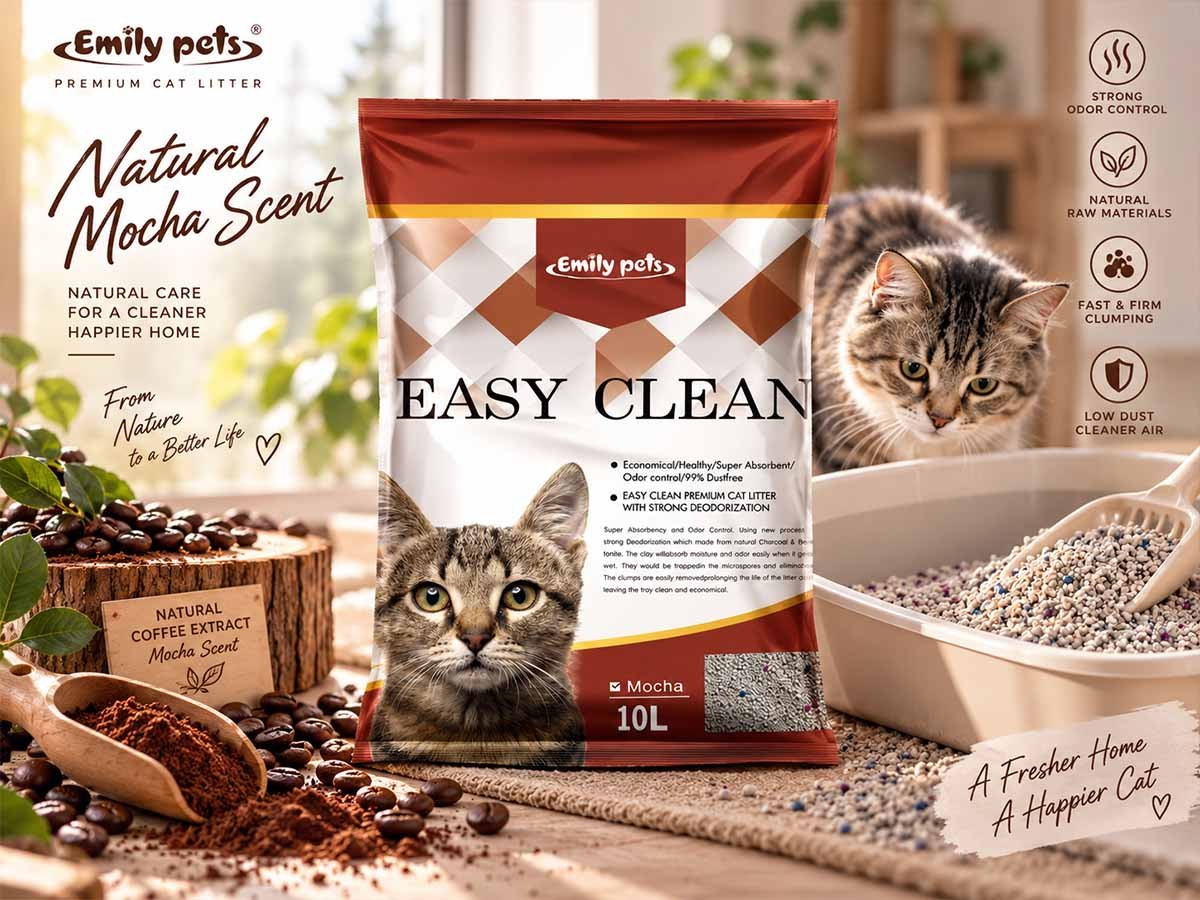
Short answer. Every importer eventually needs a working list of cat litter brands — the kind you can hand to a new sales rep on day one and they will know which label to push for which customer. The most popular cat litter brands in 2026 wholesale catalogues cluster into four buckets: multi-national private-label factory groups, eco-DTC exporters, regional traditional brands, and vertically integrated factory-owned labels like Emily Pet, Cat Global and Love Sand from the PY-PET group.
These are the five brands and brand groups that consistently appear on wholesale procurement shortlists across South America, the Middle East and Southeast Asia. They are not listed in any strict quality order — they are listed by export footprint and buyer accessibility.
Big-box retailers (Walmart, Costco, Target, Carrefour, Auchan) usually sell under their own private label, but the underlying factories are a handful of large groups. As a wholesale buyer, you are more likely to be buying from these groups than from a named consumer brand. The most popular cat litter brands in retail are actually manufactured in this tier.
Brands that focus only on plant-based litter (mostly tofu and pine), usually with strong online DTC roots in the US and Europe. They buy from Asian factories and re-brand under their own label. Useful as a benchmark for what end consumers are willing to pay for eco positioning.
Brands that dominate one country or one region — strong national labels in Brazil, Saudi Arabia, Indonesia, the Philippines. Usually mineral-litter strongholds with deep retail relationships. Excellent partners if your business is regional rather than global.
Brands owned by the factory itself, with no consumer marketing layer. The PY-PET group is a good example: Emily Pet, Cat Global and Love Sand are factory-owned labels that ship under wholesale programmes, with private label OEM on top. This tier usually gives the best pricing for distributors.
Brands owned by trading companies that do not own production. They buy from the best available factory per order and re-label. Good for small trial orders, less attractive for long-term programmes because the supply chain is one layer removed from QC.
The list below is not a consumer ranking. It is a sourcing shortlist — the brands of cat litter you would actually approach if you were building a multi-tier retail programme today.
| # | Brand or group | Tier | Main products | Best buyer profile |
|---|---|---|---|---|
| 1 | Big-box private label suppliers (factory groups) | Multi-national | Tofu, bentonite, mixed | Hypermarket / supermarket chains |
| 2 | Eco-DTC tofu / pine exporters | Premium | Tofu, pine, paper | E-commerce and specialty retail |
| 3 | Regional traditional brands (LatAm, MEA, SEA) | Regional | Bentonite-heavy | Country distributors |
| 4 | Emily Pet (PY-PET) | Multi-tier factory-owned | Tofu, bentonite, cassava, pine + secondary SKUs | Distributors who want one supplier, full shelf |
| 5 | Cat Global (PY-PET) | Multi-tier factory-owned | Tofu, bentonite, cassava, pine | Distributors who want the four main formulas only |
| 6 | Love Sand (PY-PET) | Value | Tofu, bentonite, cassava, pine | Price-sensitive markets, value tier |
| 7 | Specialty sensitive-cat brands | Premium niche | Paper, pine, dust-free formulas | Pet hospital and senior-cat programmes |
| 8 | Subscription-box brands (eco position) | Premium DTC | Tofu, wood, paper | Online subscription retailers |
| 9 | Trading-company labels | Entry | Varies | Small trial orders, low commitment |
| 10 | Cassava-specialist brands | Eco mid-market | Cassava blends | Eco-positioned retail at tofu-adjacent price |
A top 10 cat litter brands list is only useful if it answers the right questions. Use the five filters below when you evaluate any shortlist.
China (mainly Shandong, Hebei, Guangdong) is the export hub for tofu, cassava and pine. The US and Turkey are the bentonite export hubs. Knowing the geography saves weeks on freight planning.
A brand with only bentonite in its range will leave gaps in your portfolio. A brand with tofu, bentonite, cassava and pine is usually a better long-term partner.
If you want to put your own bag on the shelf, the brand needs to support OEM. Factory-owned labels like the PY-PET group are usually the most flexible on artwork, MOQ and packaging. For the procurement checklist, see the private label manufacturers guide.
COA, MSDS, BSCI, ISO 9001, SGS reports — if the brand cannot send these within 48 hours, they are not a top tier brand, no matter how good the product feels.
A reliable brand will name two or three distributors it already works with (with permission). A vague answer usually means they have none.
If you are building or refreshing a wholesale portfolio and you want one supplier relationship that covers the entire list of cat litter brands you actually need, the PY-PET group is structured for exactly that.
Emily Pet is the group’s flagship brand. It carries the full spectrum: tofu, bentonite, cassava and pine as the four main formulas, plus paper, aspen shaving, bathing sand, wood shaving and cat snack as the supporting SKUs. For a buyer who wants a single supplier to fill the entire cat litter shelf section, Emily Pet is the natural anchor.
Cat Global keeps the SKU list tight to the four main formulas. If your retail programme is clean and you do not need secondary SKUs, Cat Global gives you tighter pricing, simpler QC and a tighter container plan.
Love Sand sits in the value tier of the same product family. Useful when the retail programme needs a price-tier backup alongside a premium label, or when the entry market is very price-sensitive. Production runs on the same lines with the same QC team, so you are not trading quality for price.
Procurement note. The three lines are not separate suppliers — they share one factory, one QC team and one document pack. Adding the second and third brand to your portfolio does not multiply your supplier risk.
Start with the export hubs (Shandong, Hebei, Guangdong for plant-based; Wyoming and Turkey for bentonite). Use B2B directories to shortlist 15–20 suppliers, then narrow to 5 with samples and document checks.
No. Popularity usually means strong consumer marketing, which is funded by higher margin per bag. For wholesale, factory-owned labels usually give better pricing per ton.
For most importers, one factory and 2–3 brand labels from the same factory is the most efficient setup. It keeps QC and reorders simple, and gives you pricing leverage on volume.
اتصال
Send an inquiry now to get the best price.