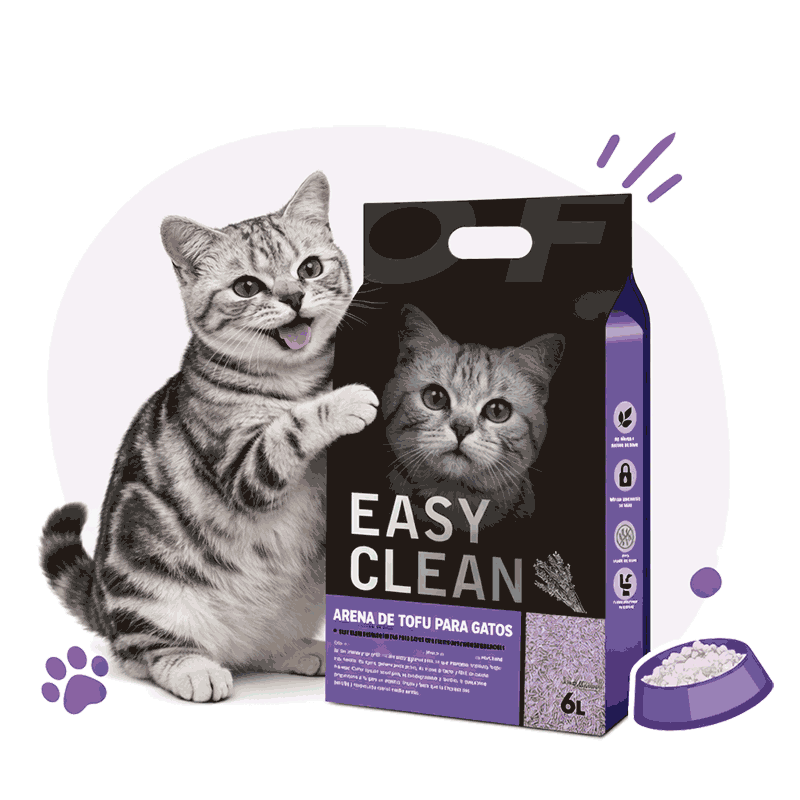
- PY-PETS’ LOVE SAND trademark has been successfully registered in Uruguay, marking the brand portfolio’s formal entry into South America and complementing prior cat litter brands registrations across multiple jurisdictions.
- The PY-PET brand portfolio now spans three customer-facing names — PY-PETS, EMILY PETS, and Cat Global — sharing a single production base at Puyuan Dalian Pet Products Co., Ltd (since 2000, 300,000+ tons/year capacity, BSIC / ISO 9001 / SGS certified).
- Bentonite cat litter remains the dominant South American cat litter category by volume — economic, fast-clumping, and familiar to retail buyers — and PY-PET has supplied it to Uruguayan distributors for years.
- Colorful tofu cat litter is the new growth category reaching Uruguay: biodegradable, flushable, lower-cost than imported bentonite alternatives, and visually distinctive on retail shelves.
- For South American importers evaluating cat litter brands from China, the verification gate is identical to any other region: third-party batch lab reports, BSIC social-compliance audit, FOB Dalian quotation, and per-batch dust + clumping + odor data.
- Uruguay’s neighbours — Brazil, Argentina, and Chile — are the next obvious expansion lanes, leveraging the same MERCOSUR-aligned customs regime that PY-PET can navigate from a Dalian-to-Montevideo sail.
LOVE SAND Trademark Registered in Uruguay — What It Means for Cat Litter Brands
You may have noticed a new Chinese-origin label on Uruguayan pet-store shelves — and wondered whether the brand behind it is worth a private-label conversation. This guide unpacks the recent LOVE SAND trademark registration in Uruguay, why it matters to importers evaluating cat litter brands from China, and what the move signals about South American demand for both bentonite and tofu formulations over the next 12 months.
The headline: PY-PETS — the parent customer-facing brand of Puyuan Dalian Pet Products Co., Ltd — has officially registered its LOVE SAND trademark in Uruguay, complementing prior cat litter brands registrations across multiple jurisdictions. This is a routine trademark action with an outsized strategic signal: the brand portfolio is now structurally present in every major South American import market.
Who this guide is for
For you if: you are an importer, distributor, or pet retail chain in Uruguay, Brazil, Argentina, or Chile evaluating cat litter brands from China for private-label or distribution agreements — or a private-label brand launching a new line at a 20FT container MOQ. Not for you if: you are an individual cat owner comparing retail bags — this is a B2B brand-strategy and export-readiness analysis.
The PY-PET Brand Portfolio: PY-PETS, EMILY PETS, and Cat Global
Behind every successful B2B cat litter brand sits a production base. The PY-PET portfolio is unusual in that three customer-facing names share a single factory, enabling fast SKU diversification without the overhead of multi-site operations.
Three customer-facing brands, one Dalian factory
PY-PETS, EMILY PETS, and Cat Global are three customer-facing brands operated by Puyuan Dalian Pet Products Co., Ltd, established in 2000 in Dalian, China. The factory runs at 300,000+ tons/year capacity with BSIC social-compliance, ISO 9001 quality management, and SGS third-party lab coverage. For South American importers, this concentration matters: a single point of contact, a single freight lane (Dalian-to-Montevideo), and a single certification stack simplify the onboarding paperwork. See the PY-PET sodium bentonite cat litter product page for the bentonite spec sheet.
Why run three brands instead of one
Multi-brand portfolio strategy is the standard playbook for Chinese cat litter brands reaching South American and European retail. Each brand targets a different retail tier: PY-PETS is the core OEM/private-label line, EMILY PETS anchors the eco-premium tofu segment, and Cat Global covers wholesale distribution and bulk orders. Importers benefit from this segmentation because they can route different SKUs through different sales channels without overlap conflict.
Why Bentonite Cat Litter Dominates South America
Bentonite cat litter has been the default South American cat litter category for over a decade. Understanding why — and how tofu is now challenging it — is the foundation for any sourcing decision.
Established demand, commodity pricing, fast clumping
Sodium bentonite cat litter brands — see the PY-PET bentonite cat litter product page — dominate the South American market because they deliver three attributes retail buyers price competitively: fast clumping (≤3 seconds with saline solution simulating cat urine salinity), low dust (≤0.5% after multi-stage dedusting), and 30-day ammonia lock. For a price-sensitive market segment, bentonite remains the rational default. Reference the PY-PET bentonite clumping cat litter product page page for retail-tier SKUs.
Most PY-PET South American customers begin their private-label journey with bentonite before expanding into tofu or mixed formulas. The MOQ is one 20FT container, with 23–26 tons per container and lead time within 20 days from payment receipt.
The new tofu challenge — colourful, flushable, eco-friendly
More and more South American customers are now paying attention to tofu cat litter — and the switch is structural, not aesthetic. Tofu cat litter brands deliver four advantages that bentonite cannot match: 100% biodegradability in soil within 4–6 weeks, flushability under ASTM D6400 compostability benchmarks, lower per-litre shipping weight, and a visually distinctive colour-tinted SKU line (Original, Green Tea, Lavender, Charcoal). For trademark context across MERCOSUR, see the WIPO Madrid System for international trademark registration.
The result is that tofu cat litter is no longer a niche curiosity on South American shelves — it is a category retailers actively request when placing new private-label orders. PY-PET’s colourful tofu line is now shipping alongside bentonite into the Uruguayan market, with the same FOB Dalian logistics corridor.
South American Market Realities for B2B Cat Litter Brands
Importing cat litter brands from China into South America is operationally distinct from importing into North America or the EU. Here is the working knowledge you need before issuing the first purchase order.
MERCOSUR customs alignment and the Dalian-to-Montevideo lane
Uruguay is a MERCOSUR member, which simplifies regional distribution: once a trademark is registered and the product is customs-cleared in Montevideo, onward distribution to Argentina, Brazil, and Paraguay uses the MERCOSUR common external tariff. The Dalian-to-Montevideo sail takes 38–42 days with direct calls; importers can plan replenishment cycles on a quarterly basis using the same factory-to-port logistics as North American lanes. Cross-reference the PY-PET corn-based cat litter (plant-based alternative) page for container-load economics.
Payment, lead time, and MOQ for the Uruguayan buyer
PY-PET cat litter brands ship from Dalian on FOB terms (EXW, CIF, and DDP quotes are available per lane on request). Standard MOQ is one 20FT container (~18 tons for tofu, ~24 tons for bentonite). Payment is T/T (telegraphic transfer), with lead time within 20 days from payment receipt for bulk orders. Private-label artwork approval adds 7–10 days before production start; first-time importers should plan for a 30–35 day end-to-end cycle from PO to port-of-arrival.
Cost economics vs. European or North American alternatives
A PY-PET private-label cat litter SKU typically lands at 30–50% below equivalent European or North American production when normalised on per-kg basis. The economic edge is structural — China-origin raw material costs, automated Dalian production at 300,000+ tons/year scale, and the Dalian-to-Montevideo ocean freight all combine to compress the landed-cost gap that importers traditionally paid for branded alternatives. Uruguayan distributors reinvest this margin into retail promotions and shelf placement. Compliance anchor: BSI Group (British Standards Institution) — compliance partner.
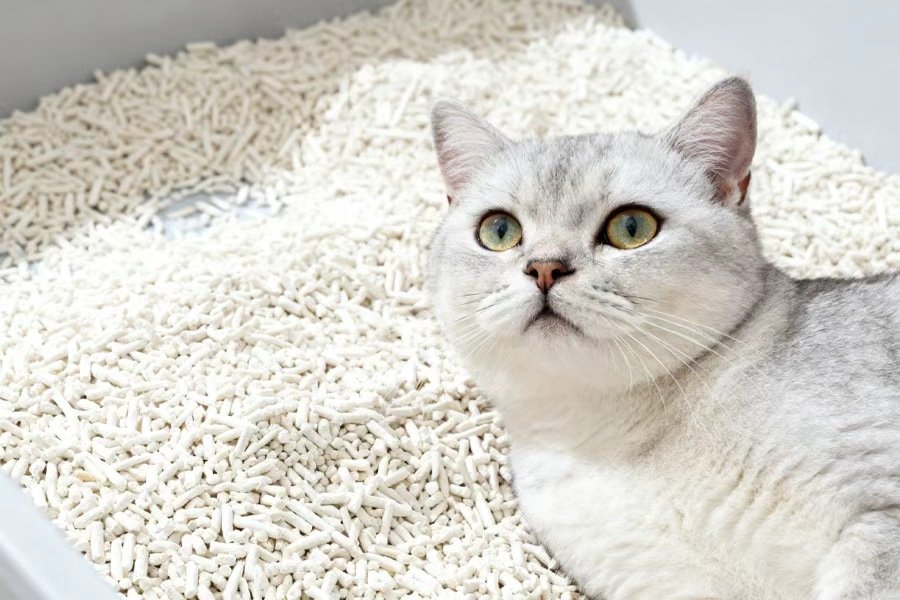
PY-PET Bentonite vs Tofu — Head-to-Head for South American Importers
Before issuing a trial order, internalise why the bentonite and tofu categories are structurally different. The table below summarises the B2B-relevant differences across demand, freight, certification, and retailer margin.
PY-PET Bentonite vs Tofu Cat Litter for South American Importers
| B2B Attribute | Arena para gatos de bentonita | Tofu Cat Litter (Plant-Based) |
| Primary South American demand | Established (volume category) | Emerging (eco-premium category) |
| Raw material | Sodium bentonite (mined, ≥95% Wyoming-grade montmorillonite) | 100% natural soybean residue + corn or cassava starch |
| 20FT container load | 23–26 tons | 16–18 tons |
| Per-bag freight economics | Higher (heavier 2.0–3.0 mm granules) | Lower (lighter 1.6–2.5 mm pellets) |
| Dust level (export grade) | ≤0.5% after multi-stage dedusting | ≤0.5% after secondary polishing |
| Flushability / biodegradability | Not flushable | Flushable; biodegradable in soil in 4–6 weeks |
| Visual shelf differentiation | Standard clay grey | Color-tinted variants (Original, Green Tea, Lavender, Charcoal) |
| South American retail price band | Commodity-tier (price-sensitive buyers) | Eco-premium tier (margin headroom for distributors) |
| Import licence / regulatory profile | Straightforward (commodity) | Same as bentonite + flushability claim substantiation |
Light Grid Accent 1 styling; header row shaded #1F3A5F with white bold text. Headline columns flag the B2B-relevant differences — South American demand, freight cost, flushability, retail price band.
What Uruguayan and South American Buyers Should Verify Before Importing
Not every Alibaba trading-company response is a factory. Use this verification gate before issuing the first purchase order — every step is verifiable from your office in Montevideo, São Paulo, or Buenos Aires without flying to Dalian.
1. Request a third-party batch lab report
Do not rely on a factory’s internal QC certificate. Require an SGS, Intertek, or equivalent third-party lab report per production batch, covering at minimum: dust content (≤0.5%), clumping speed (≤3 seconds with saline solution), moisture content (≤10%), and aflatoxin levels (<5 µg/kg for food-contact-grade tofu SKUs).
2. Verify BSIC social-compliance audit status
BSIC (Business Social Compliance Initiative) is the de facto retail-access requirement for South American pet retail chains supplied by Asian manufacturers. Ask for the BSIC audit ID and verify it in the public database before contract signature. PY-PET cat litter brands hold an active BSIC audit; refuse any supplier who cannot produce a current certificate.
3. Lock raw-material grade in the contract
Tofu cat litter quality starts with the soybean residue grade — food-grade residue produces lighter colour, lower odour, and better clumping. Feed-grade or industrial-grade residue cuts cost but risks aflatoxin contamination. The purchase contract should specify food-grade residue with documented supplier audits. For bentonite, lock sodium bentonite purity at ≥95% Wyoming-grade montmorillonite to ensure clumping consistency across container loads. For the plant-based alternative specification, see the PY-PET cat litter manufacturers wholesale bulk page page.
4. Confirm FOB Dalian quotation with humidity-controlled packaging
Tofu cat litter is hygroscopic — it absorbs ambient moisture. If the factory uses single-layer PE bags without a moisture barrier, product clumping can begin inside the bag during the 38–42-day ocean transit to Montevideo. Specify foil-laminate or PE-Aluminium liners for sea-freight shipments and confirm storage humidity at the China origin warehouse before locking FOB Dalian pricing.
Common Sourcing Mistakes When Importing Cat Litter Brands From China
Most cat litter brand relationships that fail in the first six months fail for one of four structural reasons. None of them are obvious at the trial-order stage.
Mistake 1 — Buying on FOB price alone
The cheapest FOB quotation often hides costs downstream: higher dust means higher return rates, inconsistent granule size means retailer complaints, and no batch-level lab reports means customs clearance delays. Always compare full landed cost, including the projected return-rate allowance.
Mistake 2 — Ignoring multi-brand complexity
When PY-PETS, EMILY PETS, and Cat Global are all operated from the same factory, importers sometimes assume they are dealing with three different factories. They are not — they share production lines, raw-material supply, and freight logistics. This concentration is an advantage (single point of accountability) but also means a single supply-chain incident affects all three brands simultaneously.
Mistake 3 — Skipping the trademark verification
A registered trademark in one country does not automatically grant protection across MERCOSUR. Verify the LOVE SAND registration in Uruguay specifically covers the cat litter class (Class 31 in the Nice Classification), and confirm whether separate filings are required for Brazil, Argentina, and Chile before importing into those markets. The WIPO Madrid System is the standard route.
Mistake 4 — Underestimating the tofu product ramp-up
Tofu cat litter brands require a different retail conversation than bentonite — eco-claims, flushability certification, and visual merchandising. Importers who default to a bentonite-style sell-in sheet underperform in tofu category adoption. Plan for a 60–90 day category education cycle with retail buyers before expecting reorder velocity.
What Comes Next — Expanding Beyond Uruguay
Uruguay is the entry point, not the destination. The PY-PET brand portfolio is positioned for sequential rollout across the rest of South America over the next 12–24 months.
Brazil, Argentina, and Chile as the next expansion lanes
Brazil and Argentina together account for the majority of South American pet retail volume. With the LOVE SAND trademark now anchored in Uruguay, the same Dalian-to-region freight economics and BSIC-certified production base can serve the broader MERCOSUR market. Chile is the next obvious Pacific-coast lane, with a 32–36 day transit from Dalian to San Antonio or Valparaíso.
Importers evaluating cat litter brands from China for the South American market should treat the Uruguay registration as a brand-portfolio signal — not a single-country commitment. The same factory, the same quality system, and the same freight economics scale to the full continent.
Preguntas frecuentes
Quick answers to the questions South American importers ask most when evaluating cat litter brands from China.
Q1. What is cat litter made of?
Modern cat litter is made from one of three feedstock families: mined sodium bentonite clay (the clumping category that dominates ~60% of global retail volume), plant-based substrates such as soybean residue, corn starch, cassava, or pine (the tofu, corn, and wood-pellet sub-categories), and silica gel crystals. PY-PET cat litter brands span bentonite and tofu lines produced on the same automated lines at our Dalian factory.
Q2. How often to change cat litter?
For clumping cat litter brands — bentonite or tofu — scoop solid waste and saturated clumps daily, top up the box to the recommended fill line, and fully replace the litter every 2–4 weeks for a single-cat household, or every 1–2 weeks for multi-cat homes. Non-clumping litters require a full box change every 7–10 days. The same rotation applies whether the bag ships from China, Brazil, or any other origin.
Q3. Can you flush cat litter?
Only flushable-labelled cat litter brands — typically ASTM D6400-certified tofu or corn-based formulas — should be flushed, and only in small clumps, one at a time. Standard plumbing accepts these in most single-family homes; older municipal sewer systems may not. Bentonite and silica-gel cat litter must never be flushed — they harden inside pipes and cause blockages that are expensive to clear.
Q4. Is cat litter toxic?
Reputable cat litter brands produced by audited factories — ISO 9001 quality management plus BSIC social compliance, with per-batch third-party lab reports — are non-toxic under normal use. Tofu cat litter from food-grade soybean residue is the safest option for kittens and sensitive cats, with aflatoxin levels typically below 5 µg/kg. Bentonite is non-toxic but its dust can aggravate feline respiratory conditions over long exposure.
Q5. Why is cat litter so expensive?
Cat litter brands are priced by raw-material feedstock, freight density, and certification stack. Imported European or North American brands carry 30–60% landed-cost premiums versus equivalent FOB Dalian quotations because of higher domestic labour, energy, and freight costs. Private-label SKUs from a Chinese factory can deliver the same dust, clumping, and odor specs at 20–40% lower retail price when ordered at one 20FT container MOQ.
Q6. Can you be allergic to cat litter?
Yes — most cat litter allergy triggers are dust-related rather than material-related. Bentonite dust contains fine crystalline silica particles that aggravate feline and human airways. Plant-based cat litter brands — tofu, corn, wood pellet — produce <0.1% pour-time dust and are the lowest-allergen-risk option for sensitive households. Always request the per-batch dust report before bulk-importing any clumping formula into South America.
Q7. What is mineral cat litter?
Mineral cat litter is a generic term for clay-based cat litter brands — primarily sodium bentonite, the swelling-clay mineral mined in Wyoming, USA, and other volcanic regions. When liquid hits a sodium bentonite granule, the platelet structure expands and locks moisture into a scoopable clump. Premium mineral cat litter uses ≥95% Wyoming-grade montmorillonite; lower grades mix calcium bentonite or use lower-purity feedstock.