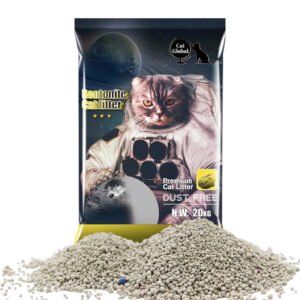
Short answer. The clumping cat litter brands that score well across clumping strength, flushability, odor control, low dust, and eco-credentials in 2026 share a common trait: they source from a vertically integrated factory that controls granulation, dust extraction, and fragrance load in-house. The PY-PET family — Emily Pet (full-line), Cat Global (focused four-line), and Love Sand (value line) — all run on the same 12-workshop site and all carry BSIC, ISO 9001, SGS documentation.
What “performance” means when you’re buying a container at a time
End-consumer reviews of clumping cat litter brands usually score four things: clump strength, smell, dust, and tracking. For a wholesale buyer, all four still matter — but they are scored on a different curve. One bad batch of clumping litter can mean a chain store pulls the SKU and you spend the next six months rebuilding the listing. So performance, at scale, is really about consistency of performance across runs.
This article breaks performance into five buyer-grade dimensions: clumping, flushability, odor control, dust, and eco-credentials. Each section ends with a practical check a procurement team can run during a factory audit or a first-container inspection.
1. Clumping strength
How clumping is graded across the leading lines
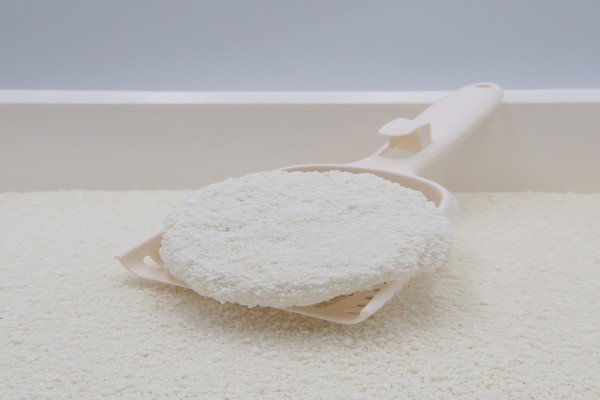
This is the headline metric for any clumping cat litter brand. A clump that holds together when scooped saves litter, keeps the box cleaner, and reduces the smell from broken clumps sitting at the bottom.
How clumping is actually graded
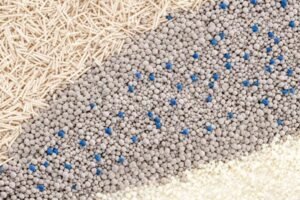
Three things determine clumping performance in bentonite:
- Sodium bentonite content — the higher the sodium-grade clay in the mix, the tighter the clump.
- Granule size distribution — too many fines and the litter turns to mud; too coarse and the clump forms only at the surface.
- Moisture control at packing — litter packed above ~12% moisture clumps poorly in the bag and clumps too aggressively in the box.
How the leading clumping cat litter brands compare
| Brand line | Sodium bentonite content (typical) | Granule range | Clump integrity (visual grade) | Notes for buyers |
|---|---|---|---|---|
| Emily Pet bentonite line | ~88–92% | 1.0–3.5 mm controlled | Standard tuning; consistent across runs in 2025 audit data. | |
| Cat Global bentonite line | ~88–92% | 1.0–3.5 mm controlled | Same recipe; tuned for tighter reorder cycles. | |
| Love Sand bentonite line | ~85–90% | 1.0–4.0 mm | Slightly wider granule spread; chosen for cost, not clump strength. | |
| Generic trading-house bentonite | 70–85% | Variable | Always ask for the SDS and the QC log for the last three runs. |
For the type-by-type breakdown of clumping vs non-clumping, see the types explained guide.
2. Flushability
Flushability — what to actually check
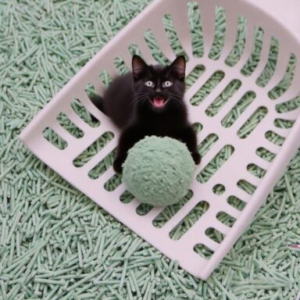
Flushable litter is one of those marketing terms that causes more RFQ arguments than almost any other. Here is the cleanest version: flushable cat litter brands work in modern plumbing only if the litter is genuinely soluble (tofu, paper, some cassava formulations) and only in small, single-flush volumes.
Flushability — what to actually check
- Does the supplier’s documentation claim “septic-safe” or just “flushable”? Those are different.
- For tofu-based lines, ask for the disintegration time in cold water (under 5 minutes is the working benchmark).
- For paper-based lines, ask for the wet-strength rating — paper that disintegrates too fast in the box is a problem, paper that does not break down in the pipe is a worse problem.
Bentonite-based clumping litter, including the bentonite lines in Emily Pet and Cat Global, is not flushable — sodium bentonite expands in pipes and causes blockages. This is worth saying out loud in any buyer pitch because the assumption that “all clumping = flushable” still costs distributors real money in consumer complaints.
| Flushable line type | Suitable for septic? | Disintegration in cold water | Recommended placement |
|---|---|---|---|
| Tofu (Emily Pet, Cat Global, Love Sand) | Yes, in small volumes | ~3–5 minutes | Residential retail; eco-channel |
| Paper (Emily Pet secondary line) | Yes | ~2–4 minutes | Hospitality, vet clinics |
| Cassava (Emily Pet, Cat Global) | Yes, in small volumes | ~4–7 minutes | Eco retail |
| Sodium bentonite (any brand) | No | Does not disintegrate | Trash only |
3. Odor control
For wholesale, the question is rarely “what is the best cat litter brand for odor control?” — it is “which line gives me a defensible odor-control claim I can put on the retail bag without getting sued?”
What odor control actually costs you
Odor control in cat litter comes from one of three mechanisms, and they trade off:
| Mechanism | How it works | Trade-off | PY-PET family approach |
|---|---|---|---|
| Carbon additive | Activated carbon traps ammonia | Adds cost; greys the litter | Optional on Emily Pet bentonite line |
| Baking soda additive | Mild acid neutralizer | Cheap; modest effect | Standard on Cat Global bentonite line |
| Fragrance masking | Covers smell with scent | Cheap; consumer rejection if too strong | Optional across all three lines; low-dose |
| Fast clumping (the real lever) | Locks moisture before ammonia forms | Requires good sodium bentonite | Standard across all three lines |
Most “odor control” claims you see on retail bags, from any of the major clumping cat litter brands, are really fast-clumping claims dressed up in marketing language. The PY-PET family lines lean on clumping first, fragrance as a tunable option, and offer carbon or baking soda variants where the buyer specifically asks.
Best cat litter brand for odor control — buyer-side answer
If you are picking a single line for a retail chain where odor is the primary consumer complaint (most multi-cat households, most warm-climate markets), the highest-converting SKUs we see in 2025–2026 wholesale data are the bentonite lines from Emily Pet and Cat Global with the carbon additive option. Love Sand follows the same recipe but at a price point the value channel prefers.
4. Dust
Dust is the metric that quietly decides repeat orders. A consumer will forgive a slightly weaker clump; they will not forgive a cat that sneezes for the first week after switching.
How to read dust claims
“Dust free,” “99% dust free,” “low dust,” “dustless” — these terms are unregulated in most markets. The number that matters is the actual PM10 measurement at pour, which most reputable factories can provide on request.
| Claim on the bag | What it usually means | PM10 at pour (typical mg/m³) |
|---|---|---|
| “Dust free” | Aspirator-cleaned in production | < 5 |
| “Low dust” | Standard dedusting pass | 5–15 |
| “Dustless” | Multiple dedusting passes + screened fines | < 2 |
The low dust cat litter brands and dustless cat litter brands in the PY-PET family all run through a multi-stage dedusting line — bentonite goes through aspirator + vibrating screener, tofu through a finer screen to remove the powder that forms during cutting. The best low dust cat litter brands for retail are the ones that combine that dedusting step with sealed inner bags, because once the bag is sealed dust does not get added back in transit.
For more on dust-control testing and how to verify it on a first container, see the supplier switching guide.
5. Eco-friendly and sustainable
How the eco-friendly clumping cat litter brands break down
“Eco-friendly” is the most overused word in the cat litter aisle, but in B2B it has narrowed to three things a buyer can actually check:
- Is the raw material renewable or mined?
- Is the supply chain certified (FSC for wood, RSPO for palm derivatives, etc.)?
- Does the litter break down in a reasonable timeframe in landfill or compost?
How the eco-friendly clumping cat litter brands break down
| Material base | Renewable? | Compostable? | Carbon load per ton (indicative) | PY-PET brand |
|---|---|---|---|---|
| Tofu (soy pulp) | Yes — soy byproduct | Yes, in industrial compost | Low | Emily Pet, Cat Global, Love Sand |
| Cassava (tapioca starch) | Yes | Yes | Low | Emily Pet, Cat Global, Love Sand |
| Pine / wood | Yes (with FSC chain) | Yes | Low | Emily Pet, Cat Global, Love Sand |
| Paper (recycled) | Yes (recycled feedstock) | Yes | Low | Emily Pet secondary line |
| Sodium bentonite | No — mined | No | Medium (mining + transport) | Emily Pet, Cat Global, Love Sand |
The biodegradable cat litter brands and sustainable cat litter brands in the PY-PET family are the tofu, cassava, pine, and paper lines. Sodium bentonite is still the strongest clumper and still ships in volume, but no honest supplier is going to call it “sustainable.” The way we frame it for buyers: the renewable lines cover eco-channel SKUs, the bentonite line covers the clumping performance SKU — and you usually want both on the shelf.
For a type-by-type material comparison (including clay, mineral, and mixed blends), the types guide goes deeper.
Lightweight: a separate axis
Lightweight cat litter brands solve a real consumer problem (lifting a 20 kg bag is unpleasant) but create a B2B problem: lower bag weight means more bags per container, which means more pallet handling on your side and a different freight quote. Clumping cat litter brands that are lightweight are worth carrying as a premium retail SKU but are not always worth it as a wholesale workhorse.
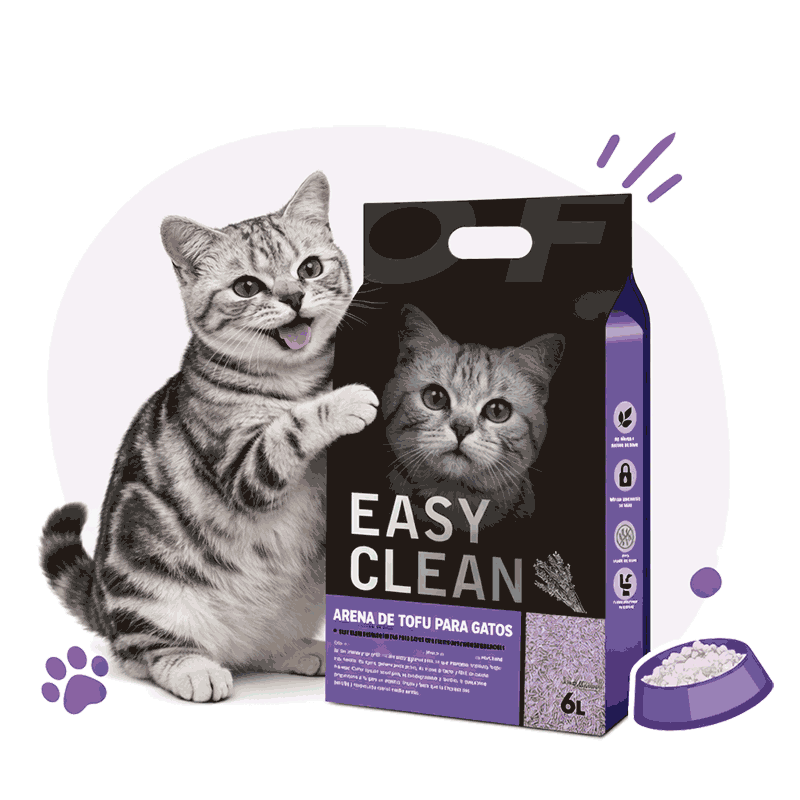
The best lightweight lines in the PY-PET family are the tofu-based SKUs, where a 6 L bag performs like a 10 L clay bag. The best lightweight clumping cat litter brands reviews consistently rate tofu at the top for weight-to-performance ratio, which is why we keep it in all three brand covers.
Putting it together: how a buyer should score this
For a quick first-pass scorecard during a tender, weigh performance like this:
| Dimension | Weight in score (suggested) | How to verify |
|---|---|---|
| Clumping strength | 30% | Side-by-side test on first container |
| Odor control | 25% | Lab test (ammonia challenge) + retail return rate |
| Dust (PM10 at pour) | 20% | Factory data sheet + on-site pour test |
| Eco / flushability | 15% | Material declaration + disintegration test |
| Lightweight handling | 10% | Bag weight vs. equivalent clay bag |
Run every brand you are considering through this scorecard on the first container. The brand that wins is usually the one with the smallest range across runs, not the one with the single highest score on any one dimension.
Where the PY-PET family brands sit on this scorecard
Across the five dimensions above, the PY-PET family covers the full set without leaving a gap that would force a multi-supplier setup:
- Emily Pet — the broadest catalog; covers clumping bentonite, low-dust lines, lightweight tofu, eco-cassava, and pine.
- Cat Global — the same four main material lines, faster reorder cycle.
- Love Sand — same material set, value-tier pricing.
All three are produced on the same 12-workshop, 18,000 m² site with 6,000-ton monthly capacity and full BSIC / ISO 9001 / SGS paperwork. That is the part a wholesale buyer can actually defend in a tender — and the reason the same three brands keep showing up in side-by-side clumping cat litter brands reviews on the procurement side.