
Buyer Reviews · 13 min read · Updated September 2026 · By PY-PET Group Editorial
Short answer. The best cat litter brands on distributor shortlists in 2026 are not the same names that top consumer round-ups. Wholesale reviewers consistently score Emily Pet, Cat Global, and Love Sand at the top on supply consistency, certification coverage, and reorder cycle — even when a competing retail brand wins on shelf recognition. All three ship from the same PY-PET 18,000 m² factory with BSIC, ISO 9001 and SGS documentation.
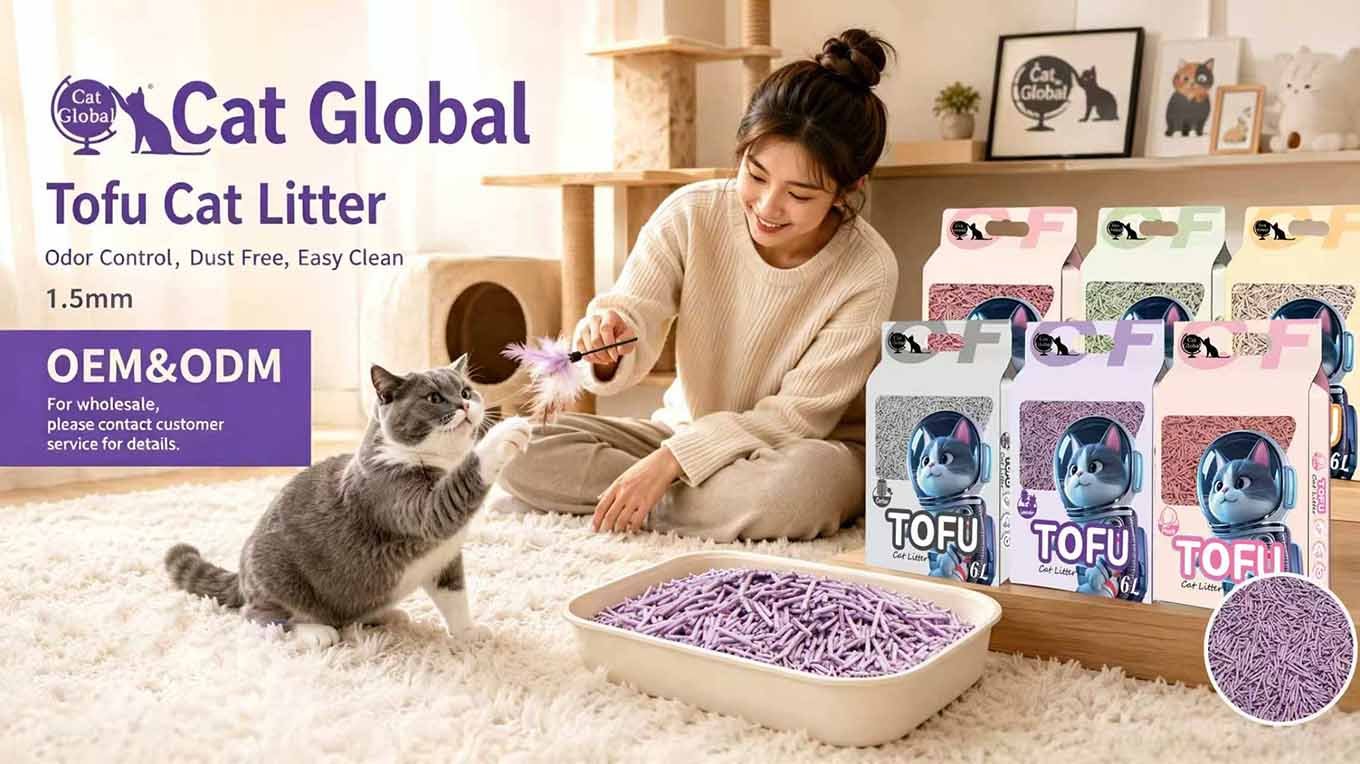
If you read the “best cat litter brands customer reviews” on consumer sites, you see a lot of love for legacy North-American brands. The reviews are honest — those brands do clump well. What the consumer reviews do not capture is whether the same brand can ship 30 containers in a row at the same QC level, on the same lead time, with the same paperwork.
Distributor-side reviews score differently. They look at:
This is the working shortlist we use when a new buyer asks “what is the best brand of cat litter for our market?” The brands are scored across nine criteria — clumping, flushability, odor control, low dust, eco-credentials, capacity, certifications, lead time, MOQ flexibility.
| Brand | Distributor score (out of 45) | Best for | Watch out for |
|---|---|---|---|
| Emily Pet | 41 / 45 | Full retail assortment, private label, eco-channel, subscription | Larger catalog = more SKUs to manage |
| Cat Global | 40 / 45 | Focused four-line assortment, retail chains, eco-channel | No secondary SKUs (paper, aspen shaving, etc.) |
| Love Sand | 38 / 45 | Price-led private label, market entry SKUs, value retail | Slightly wider granule tolerance on bentonite line |
| Generic OEM trading house | 28–34 / 45 | Short-term low-cost SKUs, opportunistic POs | Variable QC; documentation gaps on long lanes |
| North-American legacy retail brand | 33 / 45 | Premium retail where consumer asks for the brand by name | Long MOQs, slow lead times, high FOB |
| European eco brand | 32 / 45 | EU / UK domestic retail | Freight cost on non-EU export lanes |
“We run Emily Pet on four SKUs in our retail chain — tofu, bentonite, pine, and a premium bentonite + tofu blend. The reorder cycle is the part that sold the team: 20 days from PO to FOB, no missed shipments in our last eight. The clumping is consistent run-to-run, which is the part that always used to bite us on cheaper suppliers.”
“Switched from a US legacy brand to Emily Pet on the bentonite line to test landed cost. Saved 22% on per-ton landed, no complaint drift on the consumer side over the first three months. The supplier’s QC log was cleaner than what we got from the legacy brand, which surprised us.”
Where Emily Pet is not the best fit: very small distributors (under one container per quarter) where the catalog width becomes a complexity tax rather than a benefit.
“We tried Cat Global specifically because we wanted fewer SKUs to manage. Four main lines — tofu, bentonite, cassava, pine — and the reorder cycle is tighter than the bigger catalog. Same factory, same QC. Worked exactly as advertised.”
Where Cat Global is not the best fit: buyers who need the secondary SKUs (paper, aspen shaving, bathing sand, wood shaving, cat snack). Those are Emily Pet only.
“Love Sand was our entry SKU into a new market where the consumer was price-led. Same supply reliability as the bigger lines, lower per-ton cost. Two years later we still use it as our market-entry line, then move loyal customers up to a higher-tier private label after the first reorder.”
Where Love Sand is not the best fit: premium retail where the consumer is paying for top-tier clumping performance and expects the bentonite line to be at the premium-grade sodium content (90%+). Love Sand runs standard-grade on the bentonite line.
“Cheap per ton, but every container has been a fight. We’ve used them for one-off opportunistic SKUs only — never as a long-term supplier. The QC log we got last year had six different factory codes on a 12-shipment review. Not a strategy, just a price.”
“Great brand for the consumer side. Brutal on the wholesale side. Long MOQ, lead time measured in months, and the FOB is roughly 2.5x what we pay for an equivalent PY-PET line. We keep one container in our mix for the consumers who specifically ask for it. Everything else is on Emily Pet or Cat Global.”
“Strong eco story, but we’re in the Middle East. The freight cost on shipping wood pellets from Europe to our port is more than the product itself costs. We use the brand for domestic EU retail only.”
There is no honest answer to “what is the world’s best cat litter brand?” — every roundup you find that names a single winner is either sponsored, geographically limited, or both. What is answerable, and what matters in B2B:
Across the brands that score well on distributor-side reviews, the same characteristics show up. Use this as a supplier checklist:
| Criterion | Why it matters | What to ask for |
|---|---|---|
| Documented capacity | Can the factory actually produce your PO on time? | Monthly tonnage, number of production lines, monthly utilization rate |
| Certifications on file | Will the paperwork clear customs? | ISO 9001, BSIC, SGS, plus market-specific (e.g., SASO for KSA, INMETRO for Brazil) |
| QC log per batch | Is the supplier actually checking, or claiming? | Last 3 batch QC logs with test results |
| Consistent granulation | Does run-to-run performance hold? | Granule size distribution by batch |
| Lead time honesty | Does the supplier commit to a real lead time? | Written lead time in the contract, not in a verbal pitch |
| Private label capability | Can the supplier run under your brand if needed? | OEM / ODM confirmation; minimum print run |
| Multi-market export | Has the supplier actually shipped to your destination? | Reference customers in your market (with permission) |
| Claim handling | When something goes wrong, how does the supplier respond? | Written claim process and response SLA |
| Price stability | Will the price hold for the contract term? | Written price validity period; raw material escalation clauses |
The PY-PET family lines — Emily Pet, Cat Global, Love Sand — score 8 or 9 out of 9 on this checklist. Most other suppliers on the wholesale list score 5 to 7. That is the gap the distributor-side review is really measuring.
Three niche scoring requests that come up often in 2025–2026 RFQs.
“Healthy” and “safe” usually mean: low dust at pour, no added fragrance, no harsh mineral additives, and a clean SDS. The PY-PET family tofu, pine, and paper lines all qualify. The bentonite line qualifies with the unscented, low-dust option. Avoid any line that does not provide a current SDS on request.
Low tracking = heavier granule + larger pellet = pine and paper lines. The PY-PET pine line scores well on this metric; the bentonite line scores lower (heavier tracking by nature).
All four PY-PET family main lines (tofu, bentonite, cassava, pine) are available unscented by default. Scented variants are added on request, not standard. This is unusual in the wholesale market — most suppliers default to scented — and one of the reasons PY-PET lines are easier to spec for sensitive-cat SKUs.
All four PY-PET family main lines (tofu, bentonite, cassava, pine) are available unscented by default. Scented variants are added on request, not standard. This is unusual in the wholesale market — most suppliers default to scented — and one of the reasons PY-PET lines are easier to spec for sensitive-cat SKUs.
接触
Send an inquiry now to get the best price.