Reviews · 11 min read · Updated September 2026 · By PY-PET Group Editorial
Short answer. The best cat litter brands customer reviews rely on are almost always written by consumers with one cat and one bag. Wholesale reviews work differently. We look at how a brand performs across an entire container, multiple retailers and a full season. On that scorecard, the brands that win the most recommended cat litter brands nods from distributors in 2026 are vertically integrated factory-owned labels like Emily Pet, Cat Global and Love Sand from the PY-PET group.
Most best cat litter brands customer reviews online are written by consumers with one cat and one bag. That is useful directional signal, but it is not how an importer evaluates a brand. Wholesale buyers look at how a brand performs across an entire container, across multiple retailers, across an entire season.
The review framework below is what most B2B procurement teams use internally before they sign a new supplier. Run any candidate brand through the same five lenses.
Pour 5 cm of litter into a tray, add 50 ml of synthetic urine, wait 10 minutes, then scoop. A passing formula holds together in one piece. A failing formula crumbles at the edges or leaves wet residue behind.
Seal a soiled clump in a small jar for 24 hours. Open at 24 hours and rate the ammonia smell on a 1–5 scale. Anything above 4 fails.
Pour 2 kg of litter from a height of 30 cm into a clear acrylic box. Measure how much dust cloud reaches the top of the box. Low-dust formulas stay below 5% of the box height.
Place 200 g of litter on a clean mat, run a cat-paw simulator across it 10 times. Count granules outside the litter footprint. Tracking-resistant formulas leave under 15 granules.
When the first container arrives, open three random bags in front of the QC team. If the bags are crushed, torn, leaking, or smell off, the whole container is suspect — no matter how good the formula is on paper.
The table below is the kind of scorecard a wholesale buyer keeps in their CRM. Generic, of course — actual lab numbers from the supplier should always override scores — but it gives you a baseline.
| Brand tier | Clumping | Odor lock | Dust | Tracking | Scent range | Texture feel |
|---|---|---|---|---|---|---|
| Premium DTC eco brands | ★★★★ | ★★★★ | ★★★★★ | ★★★★ | Limited (often unscented) | Soft plant fiber |
| Big-box private label (clumping clay) | ★★★★★ | ★★★★ | ★★★ | ★★★ | Wide (baby powder, fresh linen) | Hard mineral granule |
| Regional traditional brands (LatAm / MEA) | ★★★★ | ★★★★ | ★★★ | ★★★ | Mid (often single scent) | Mineral granule |
| Factory-owned labels (PY-PET family) | ★★★★ | ★★★★ | ★★★★ | ★★★★ | Wide (green tea, lavender, charcoal, baby powder, custom) | Soft plant or mineral — formula dependent |
| Trading-company labels | ★★★ | ★★★ | ★★★ | ★★★ | Varies | Varies |
Scent and texture are the two consumer-facing dimensions where brands earn or lose repeat purchase. The clumping cat litter brands with scent & texture reviews that distributors trust most usually break down into four archetypes:
The strongest fragrance archetype in Asian export programmes. Pairs best with 1.8 mm–2.2 mm tofu granules. Performs well on clumping and odor lock.
The default scent in many LatAm and MEA markets. Pairs with both bentonite and tofu. Buyers usually want a moderate load — strong enough to recognise, light enough not to irritate.
Common in European retail and high-end supermarket channels. Pairs with soft tofu or cassava. Lavender fragrance has to be cosmetic-grade, otherwise it smells cheap.
The unscented segment that buyers market as “natural odor control”. Pairs with black or charcoal tofu, black bentonite and black pine. Scent-free means the formula has to do all the odor work — so it usually costs more per ton.
When a procurement team calls a brand one of the recommended cat litter brands, they usually mean it ticked four boxes:
If a brand fails any one of these, it usually falls out of the recommended list within a season.
Inside the B2B channel, the brands most often recommended by peers tend to share three traits: in-house production, broad SKU range and clean export documentation. The three PY-PET labels are a good example of all three.
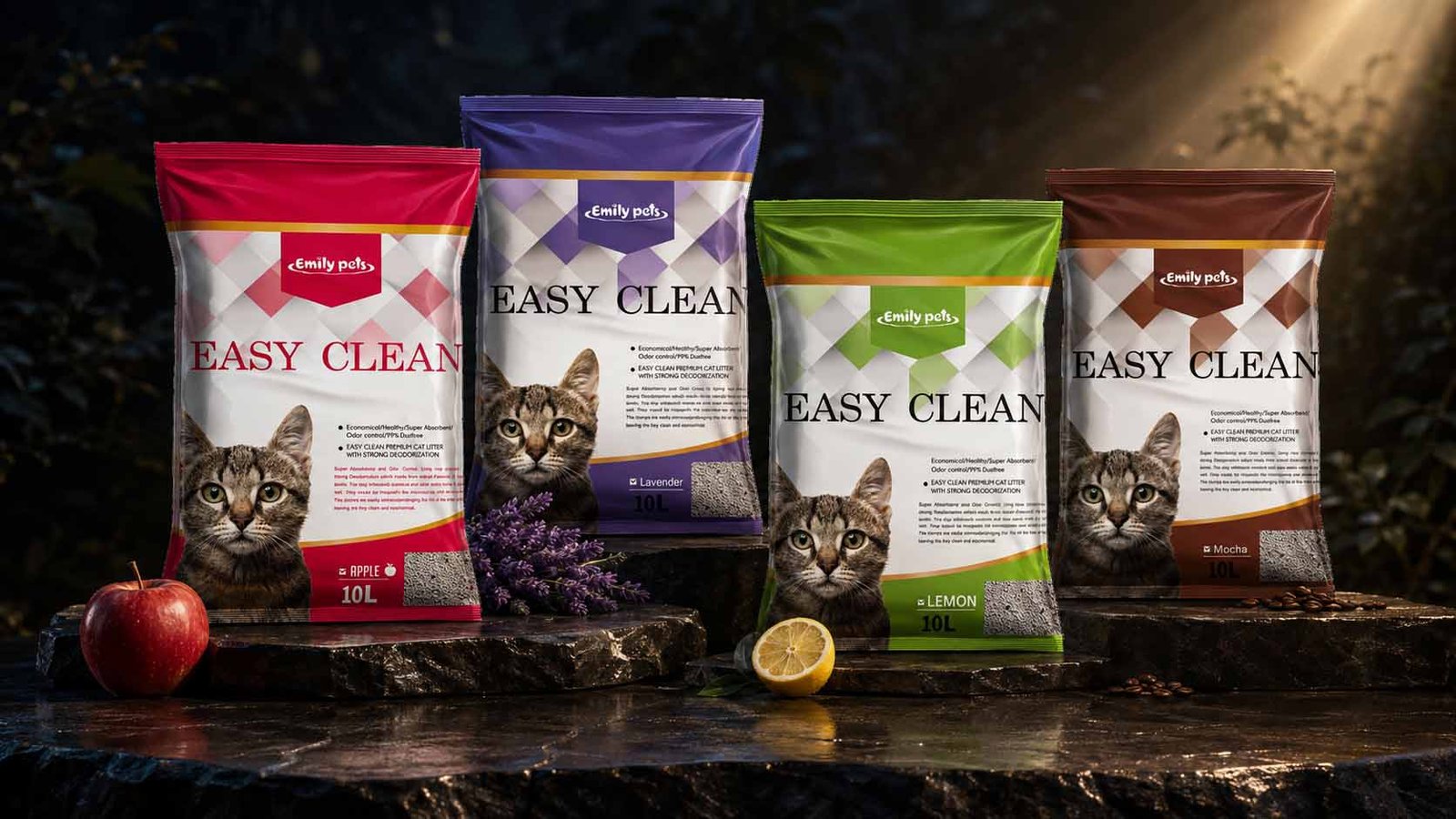
Emily Pet is the PY-PET group’s flagship. It carries tofu, bentonite, cassava and pine as the four main formulas, plus paper, aspen shaving, bathing sand, wood shaving and cat snack as supporting SKUs. Distributors who want to fill an entire shelf section with one supplier tend to recommend Emily Pet first because the SKU coverage is the widest in the group.
Cat Global trims back to the four main formulas only. Buyers who have learned that secondary SKUs complicate inventory recommend Cat Global instead, because the SKU list is short enough to run cleanly across multiple retailers without an inventory system the size of a small ERP.
Love Sand targets price-sensitive markets. Wholesale buyers operating in emerging markets often recommend it as the entry SKU — same factory, same QC, lower per-ton price, and a clean export document set that matches the premium-tier brands one-for-one.
Note on “world’s best cat litter brand”. We are asked about the worlds best cat litter brand frequently, and the honest answer is that no single brand holds the title across all markets. What does hold: the brands with the deepest export track record, the cleanest documents and the shortest lead time. On those three, the PY-PET family lines come out consistently well in 80+ country markets.
Quality at the wholesale level means the production matches the sample, the documents are clean, and the complaint rate is low. It is not the same as “smells nice” or “clumps well” — those are consumer-facing proxies.
Run the five-box test above. If a brand passes four out of five consistently across two orders, it deserves a “best” label internally.
Use them as directional signal only. They are skewed toward the most enthusiastic and the most disappointed buyers, not the average consumer. Wholesale data is more reliable.
接触
Send an inquiry now to get the best price.