
Sustainability Guide · 10 min read · Updated September 2026 · By PY-PET Group Editorial
compostable cat litter brands
eco credentials
plant-based
sustainable sourcing
Short answer. The compostable cat litter brands worth carrying in 2026 sit in three families: tofu (soy-based, food industry by-product), pine (FSC-certified wood fiber), and paper (recycled stream). Of the clumping cat litter brands with eco-friendly credentials, tofu is the most balanced — light, flushable, low dust, fast clumping. Best natural cat litter brands in wholesale consistently anchor on plant-based raw materials with documented chain-of-custody.
The phrase has been used so loosely that it has almost lost meaning. As a wholesale buyer, you need to separate four distinct claims, because each one carries different evidence and different retail value.
Made from soybean pulp, cassava starch, pine fiber or recycled paper. Plant-based litters are usually biodegradable and often flushable. This is the most common eco claim and the easiest to verify — just look at the raw material list.
Breaks down under natural conditions within a defined period (usually 6–24 months). Biodegradable litters are not always plant-based — some mineral blends can claim partial biodegradability through binder breakdown.
Compostable cat litter brands meet a stricter standard — usually EN 13432 (EU), ASTM D6400 (US) or equivalent. The litter must break down in a municipal or industrial composting facility within a defined cycle and must not leave toxic residue. Home-compostable is a separate, stricter claim.
The raw material is sourced from a verified sustainable supply chain — FSC-certified pine, food-industry by-product tofu, recycled paper with chain-of-custody. This is the deepest claim and the hardest to fake.
Below is a working map of which natural families sit where on the eco ladder. Wholesale buyers who understand this map can price eco SKUs correctly and avoid over-paying for weak claims.
| Material | Plant-based | 生分解性 | Compostable | Sustainably sourced | Tier |
|---|---|---|---|---|---|
| Tofu | Yes | Yes | Often (depends on binder) | Often (food industry by-product) | Premium / mid |
| Cassava | Yes | Yes | Often | Often | Mid |
| Pine | Yes | Yes | Often (especially pellets) | Yes (FSC available) | Premium |
| Paper | Yes (recycled) | Yes | Often | Yes (recycled stream) | Premium niche |
| Bentonite (mineral) | No | No (stable mineral) | No | Varies (strip-mining concerns) | Value / mid |
The growth of non clay cat litter brands is structural, not a fad. Three forces are pushing it.
Urban apartment living means more litter boxes per square metre. Lighter, dust-free plant-based litter is easier to handle in a small space and easier to dispose of down a building’s plumbing.
The EU is moving toward stricter rules on mineral extraction waste and packaging recyclability. Plant-based litter, especially in paper or compostable bags, sits on the right side of those rules.
Younger pet owners choose products based on sustainability, not just price. Eco-positioned SKUs in retail shelves convert at 1.5–2x the rate of value-tier SKUs in the 25–40 age bracket.
Eco claims are the easiest to fake, so the verification discipline is important. Use the five-step process below.
ASTM D5338 or OECD 301B are the working standards. A supplier that claims “biodegradable” without one of these reports is making a marketing claim, not a technical claim.
EN 13432, ASTM D6400, or OK Compost / Seedling mark. If the supplier does not have one, the “compostable” label on the bag is not defensible.
FSC for pine, food-grade certificate for tofu, recycled stream certificate for paper. The supply chain is the part that is hardest to fake, so this is where you find the real eco brands.
Eco litter in non-recyclable plastic bags is a contradiction. Look for mono-material PE, kraft paper bags with PE liner, or fully compostable bioplastic bags.
Real eco brands publish a sustainability report, a baseline carbon footprint, and progress against targets. The brand that does not publish anything is the one whose eco story lives only on the bag.
The PY-PET group is built on plant-based raw materials (tofu, cassava, pine) and runs export documentation aligned with the EU, US and Asian sustainability frameworks. The three brand labels cover the eco ladder from premium to value.
Emily Pet is the only PY-PET label that carries every eco family plus the secondary SKUs: tofu, bentonite, cassava, pine as the four main formulas, plus paper, aspen shaving, bathing sand, wood shaving and cat snack. If your retail programme wants a fully plant-based shelf plus one mineral SKU for price-tier backup, Emily Pet is the easiest single-supplier route.
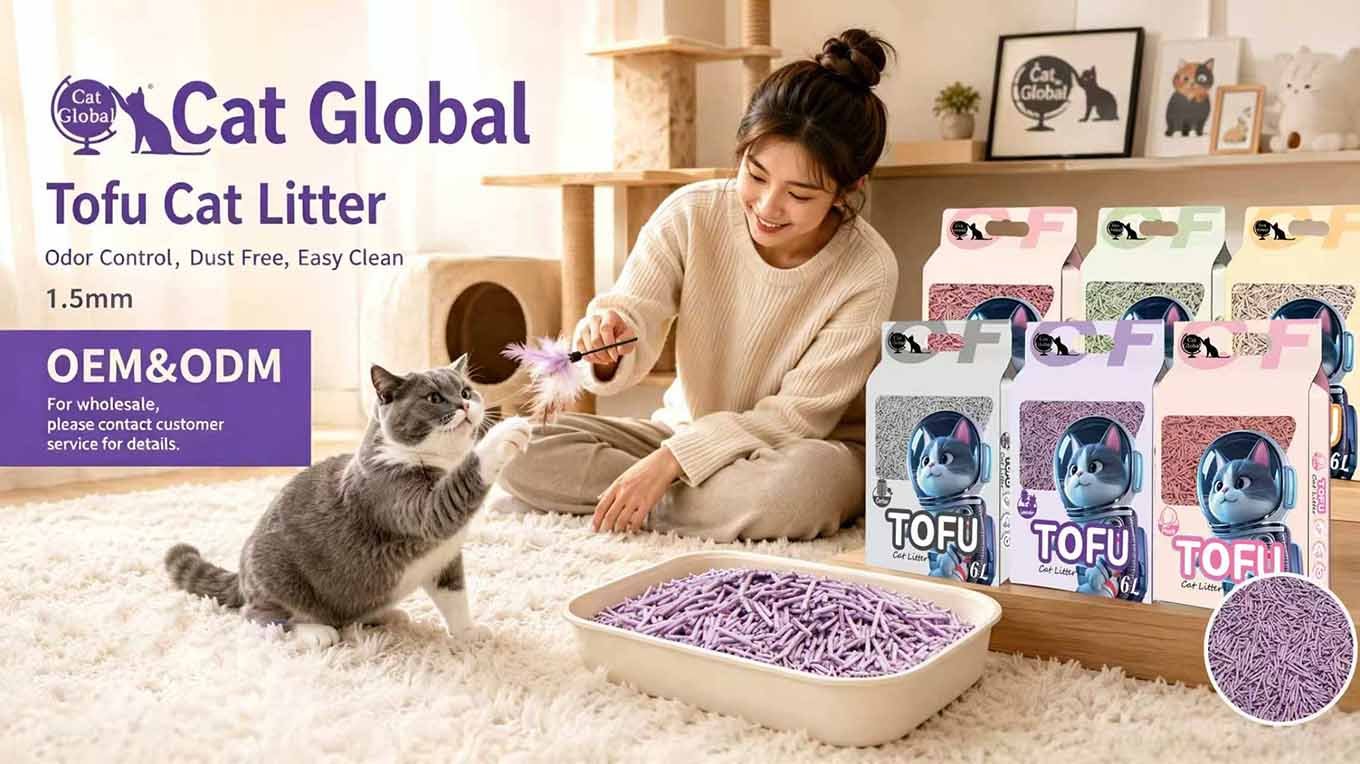
Cat Global trims to the four main formulas only — tofu, bentonite, cassava and pine. For a buyer who wants the eco story built around tofu, cassava and pine without the secondary SKUs, Cat Global is the cleaner entry point.
Love Sand runs on the same lines, with the same documentation, at a lower per-ton price. It is the right answer when the retail programme wants the eco materials but the price point is closer to value than premium — and the buyer still needs the supply chain to stand up to a sustainability audit.
Sustainability note. All three PY-PET lines run on the same 18,000 m² site with the same QC team, so the eco documentation you receive for one line is consistent across the other two. That matters when a retailer asks for FSC, OK Compost or chain-of-custody at the line level.
Some are, but most meet industrial composting standards only. Read the certificate carefully — home compostable is a much stricter claim than industrial compostable.
Modern tofu and cassava formulas close 80–90% of the gap with bentonite. Pine and paper do not clump well at all and need a different litter box system.
1.5–2.5x the equivalent bentonite SKU per kilogram, but 1.1–1.3x per use because lighter granules stretch further.
Tofu is the strongest fit — flushable, low dust, light. Pine pellets are a close second if the retailer leans harder on the natural scent story.
接触
Send an inquiry now to get the best price.