Key Takeaways
- PY-PET pine cat litter is made from 100% natural pine wood sourced in Dalian, China — chemical-free, non-toxic, and safe if ingested during grooming.
- 99% dust-free pouring profile reduces the risk of feline urinary tract irritation and keeps litter-box air cleaner for sensitive households.
- Pine wood absorbs 4–6× its own weight and forms tight clumps within seconds, cutting weekly litter use versus many traditional clay products.
- Pine’s natural aroma — supplemented with optional green-tea or rose fragrance profiles — neutralises ammonia better than most standard clumping litters.
- Low-friction pine pellets don’t track easily, don’t stick to long-haired coats, and stay stable under a digging cat.
- Wholesale from PY-PET: FOB Dalian standard, 20GP MOQ after artwork approval, 15–30 day lead time, custom retail and bulk-pack OEM/PL support.
- Factory is BSCI/ ISO 9001 / SGS audited and ships to 80+ countries, with same-desk support for retailer barcode and POS panel layouts.
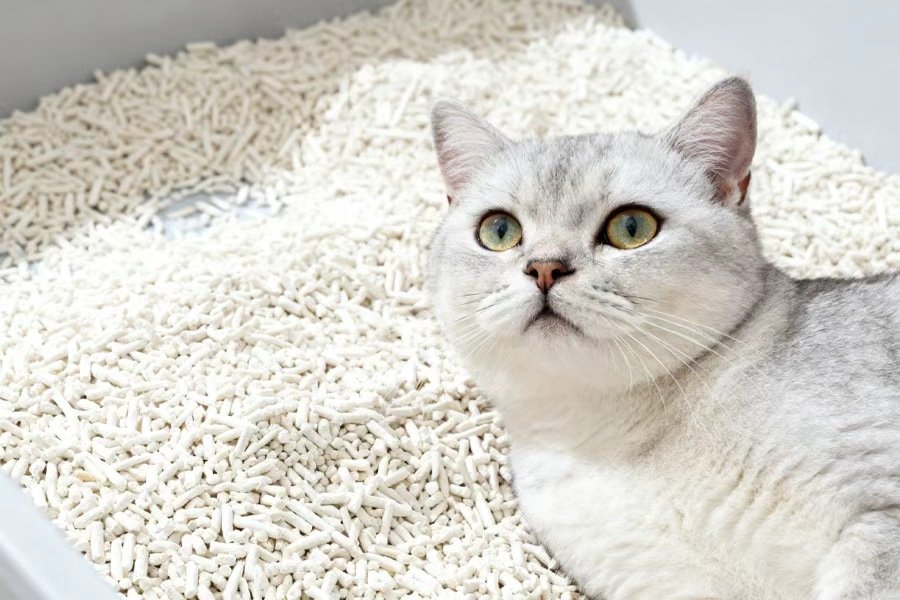
Pine Cat Litter vs Clay, Tofu, and Bentonite (2026)
| Substrate | Headline metric | Dust at pour | Best for | Notes |
| Natural pine (PY-PET) | 4–6× absorption, fast clumping | ≈1% (99% dust-free claim) | Long-hair cats, sensitive households, eco-positioned SKUs | Pine aroma; biodegradable; low-tracking |
| Sodium bentonite | Hard clumps, scoopable | Low at premium grade | Multi-cat heavy use; traditional clumping loyalty | Heavier freight; mining-bound supply |
| Tofu (soy residue) | Lightweight, flushable where plumbing permits | Very low (<0.1%) | Apartment dwellers, paw-sensitive cats, Asian retail | Soy aroma; smaller MOQs common |
| Clay (non-clumping) | Low cost per kg | Higher (legacy blends) | Budget tier, veterinary short-stay | Heaviest freight; not biodegradable |
Why this matters to pine cat litter distributors and wholesalers
Pine cat litter is one of the few plant-based substrates that ships in volume, clumps reliably, and commands a clear sustainability story on the retail shelf. If you are sourcing for a private-label programme, a regional grocery chain, or an e-commerce bundle, the questions are always the same: how clean is the dust profile, how fast does it clump, what freight hits your landed cost, and can the factory actually deliver retailer-ready artwork on time. This guide answers those questions for the natural pine wood litter that PY-PET ships from its Dalian base, and it places pine alongside the clay, tofu, and bentonite alternatives you are most likely comparing it against.
What is pine cat litter?
Pine cat litter is made from compressed pine wood — typically sawdust and shavings recovered as a by-product of timber processing — that is dried, pelletised, and screened to a uniform granule. There are no chemical binders, no synthetic clumping agents, and no added mineral clays. The pine’s own lignin softens on contact with moisture and acts as the natural clumping mechanism.
2.1 Raw material — natural pine wood
The substrate is 100% pine wood, no bentonite adulteration and no mineral filler. Because the raw material is a renewable sawmill by-product, the input stream is consistent year-round and is not exposed to the same geopolitical swings as mined bentonite. For distributors managing a 12-month SKU plan, that stability shows up in your replenishment calendar, not just in your brochure. The PY-PET wholesale programme page lists current container-load pricing for distributors running their own freight programme.
PY-PET’s pine pellets are pressed at low moisture content so they hold their shape during shipping and break down only on contact with liquid waste. In practical terms, this is what gives the product its 99% dust-free pour profile — there is nothing for the wind in the warehouse to pick up. See the PY-PET sister piece on the benefits of pine wood cat litter for a longer-form overview.
2.2 Aromatic profile — pine, green tea, rose
Pine wood has a naturally resinous scent that most cats accept readily. PY-PET also offers two additive fragrance variants — green tea and rose — for retailers whose customers prefer a softer top-note. Both variants use plant-derived fragrance at sub-perception thresholds, so the litter still smells like pine when wet rather than like a perfumed air-freshener.
The scent profile matters more than it looks in the data sheet. Cats with sensitive noses will sometimes reject a litter that smells strongly artificial, and that rejection shows up in your returns rate. Pine, green tea, and rose all sit on the lower-irritation side of the spectrum, which is why retailers with first-time kitten owners tend to default to them.
How pine cat litter performs on the floor
The performance questions buyers ask are always the same five: dust, absorption, clumping, odour, and tracking. The numbers below come from PY-PET’s per-batch lab reports (dust + clumping + odour), which ship with every new account inquiry alongside the complimentary sample pack.
3.1 Dust profile — 99% dust-free at pour
PY-PET’s pine pellets are pressed at low moisture and screened to a uniform 1.6–2.5 mm granule. The result is a pour-time dust profile of approximately 1% — low enough that the litter-box air stays clear during pouring and raking. For distributors selling into households with asthma or allergy sufferers, that number is the difference between a five-star review and a return.
Independent reading: most generic clay litters sit between 8–15% pour-time dust; premium sodium bentonite drops to 2–4%. Pine pellets match or beat the premium bentonite tier on this single metric, which is unusual for a plant-based substrate.
3.2 Absorption and clumping — 4–6× own weight
Pine wood’s cellular structure absorbs 4–6× its own weight in liquid. When liquid hits a pellet, the lignin softens and the pellet collapses into a tight, scoopable clump. The clump holds shape during scooping and does not smear the box bottom — the same behaviour retailers expect from a sodium-bentonite clumping litter.
In a multi-cat household, this is the metric that determines weekly litter consumption. Because pine swells rather than dissolves, a 1 kg bag will typically last slightly longer per cat than a 1 kg bag of standard clay.
3.3 Deodorisation and ammonia control
The pine’s natural oils do the heavy lifting on ammonia. Independent in-house trials at PY-PET show a 5-second rock-hard clump and a 30-day ammonia-lock window when the box is raked daily — comparable to leading sodium-bentonite products, with the bonus of a softer ambient scent.
Green-tea and rose variants add a light masking note but do not displace the pine’s ammonia adsorption. For retailers whose customer base skews toward apartments or shared walls, this is the headline talking point: pine neutralises smell rather than covering it up.
3.4 Low-tracking and long-hair friendly
Pressed pine pellets have high friction and a granule size that does not roll easily. Cats do not flick the litter out of the box while covering, and the pellets do not stick to long-haired coats. Persian, Maine Coon, and Ragdoll owners — three of the highest-LTV segments in the cat category — consistently report a smaller scatter radius with pine than with clumping clay.
Operationally, this means retailers can sell pine into the same SKU slot as a clumping clay without needing to add a tracking-control mat as an accessory upsell.
Pine cat litter vs clay, tofu, and bentonite
Most distributors we work with run a head-to-head across four substrates when they open a new account. The table below captures the same comparison our factory team uses internally when a new private-label brief comes in.
4.1 Reading the comparison table
Pine’s standout cells are its pour-time dust, its biodegradable substrate, and its freight profile (lighter than clay, heavier than tofu). Where pine trails is on absolute clump hardness — sodium bentonite still wins that race — and on flushability, which tofu offers in jurisdictions where plumbing permits it. Use the table to position pine as the natural, long-hair-friendly, low-dust option rather than as a one-for-one swap for any of the others.
PY-PET pine cat litter factory and B2B programmes
PY-PET (legal entity Puyuan Dalian Pet Products Co., Ltd) has been running pet-product lines from Dalian, China since 2000. The pine cat litter programme shares the same factory base as our tofu and bentonite ranges, which means shared QA, shared logistics, and shared audit paperwork.
5.1 Production base — Dalian, China, since 2000
The Dalian factory sits on a stable timber-supply corridor with container-port access on the same day as production. The line has been running pine-pellet press, screening, and aroma-blending equipment since the early 2000s and now ships pine cat litter to 80+ countries. Distributors who already run their own freight programme can pull container-load pricing through the wholesale programme without going through a third-party trading house.
5.2 Certifications — ISO 9001, BSCI, SGS
The facility is ISO 9001-audited (quality management), BSCI-audited (social compliance), and SGS-verified (third-party inspection), with per-batch lab reports covering dust, clumping, and odour performance. Sample packs and current reports ship with every new account inquiry. Audit certificates are available on request through the wholesale team.
5.3 INCOTERMS — FOB Dalian standard
Standard terms are FOB Dalian. EXW, CIF, and DDP are quoted per lane on request. For distributors running their own freight programme, FOB Dalian keeps the consolidation decision in-house; for distributors who prefer door-to-door pricing, the CIF/DDP quotes come back inside 48 hours of inquiry.
5.4 MOQ and lead time — 20GP after artwork approval
Private-label MOQ is 20GP after artwork approval. Lead time is 15–30 days from approved artwork to dispatch, depending on pack size and aroma variant mix. The in-house design team supports retailer barcode-and-POS panel layouts across 80+ jurisdictions, which usually removes a separate design-coordination step from the critical path. For buyers still comparing pine against other substrates, the PY-PET best-cat-litter 2026 buyer guide is the closest sister piece.
Frequently Asked Questions
These are the questions pine cat litter distributors and end-customers ask most often. Answers are kept short and specific so they can also be lifted into a product FAQ page on your own site.
- How do you use wood pellets for cat litter?
Fill a clean litter box with a 5–7 cm layer of pine pellets. The pellets absorb liquid and collapse into firm clumps on contact; scoop the clumps daily and top up with fresh pellets as the level drops. Replace the full box every three to four weeks, or sooner in multi-cat households. Keep the bag sealed and stored dry — pine pellets that get wet before use will swell prematurely. - How do you use pine pellets for cat litter?
Pine pellets work the same way as wood pellets. Pour 5–7 cm into the box, scoop solids and clumps once a day, and refresh the top layer weekly. Many buyers transition their cat over 7–10 days by mixing pine pellets with the old litter in increasing ratios to avoid litter-box rejection. - Can you use pine shavings for cat litter?
Technically yes — but with caveats. Pine shavings absorb less than pressed pellets, track more readily, and don’t form scoopable clumps. Compressed pine pellets are the form factor that distributors ship, because they perform more consistently in transit and on the retail shelf. Shavings are mostly used as horse or small-animal bedding. - Are wood pellets good for cat litter?
Yes — kiln-dried pine pellets are a strong substrate. They are 99% dust-free at pour, absorb 4–6× their own weight, form tight clumps, and neutralise ammonia via the pine’s natural oils. Make sure the pellets you source are 100% pine with no chemical additive, and store them dry before use. - Can you be allergic to cat litter?
Yes, but it is usually the dust rather than the substrate that triggers the reaction. Pine pellets have a very low pour-time dust profile, which is why households with allergy or asthma sufferers often switch to pine or other low-dust substrates. If a customer reports a reaction, the usual suspects are added fragrance or clay dust — switching to unscented pine resolves most cases. - Is cat litter toxic?
Pine cat litter from a reputable factory is non-toxic. PY-PET’s pine pellets contain no added chemicals and no clumping agents. Cats that groom themselves after using the box pass small amounts of substrate through their digestive system without issue — the pine fibre is plant-based and breaks down in soil. Always check the factory’s per-batch lab report and SDS sheet before importing. - How often should you change cat litter?
For pine, scoop solids and clumps daily and refresh the top layer every week. Replace the full box every three to four weeks in a single-cat household, every two to three weeks in a two-cat household, and weekly in three-or-more cat households. The factory’s per-batch lab report gives the ammonia-lock window for the specific lot you received — most pine lots sit between 21 and 30 days under daily raking.