
Category Guide · 10 min read · Updated September 2026 · By PY-PET Group Editorial
Short answer. The four cat litter sand brand families that move wholesale volume in 2026 are bentonite (the workhorse), tofu (the eco-premium growth line), cassava (the eco-mid option) and pine (the eco-premium natural line). Add paper, wood shaving and bathing sand for niche programmes. A natural cat litter brand line and a bentonite line on the same shelf usually covers 90% of regional demand.
If your sales team cannot answer “what is the difference between the green bag and the blue bag” inside ten seconds, the retail buyer will move on. A clean classification chart is not a marketing tool — it is a sales tool. It is also the only way to make sure your PO math actually closes at the container level.
The classification below covers the four main families and three secondary families. Together they account for essentially all wholesale volume in 2026.
Raw material: sodium bentonite clay, with optional calcium bentonite blend. The original clumping litter, still the spine of mid and value supermarket programmes.
If your market is dominated by value-tier supermarkets, the bentonite cat litter brands in your portfolio still move the most tonnage. They are the safety net of any wholesale programme.
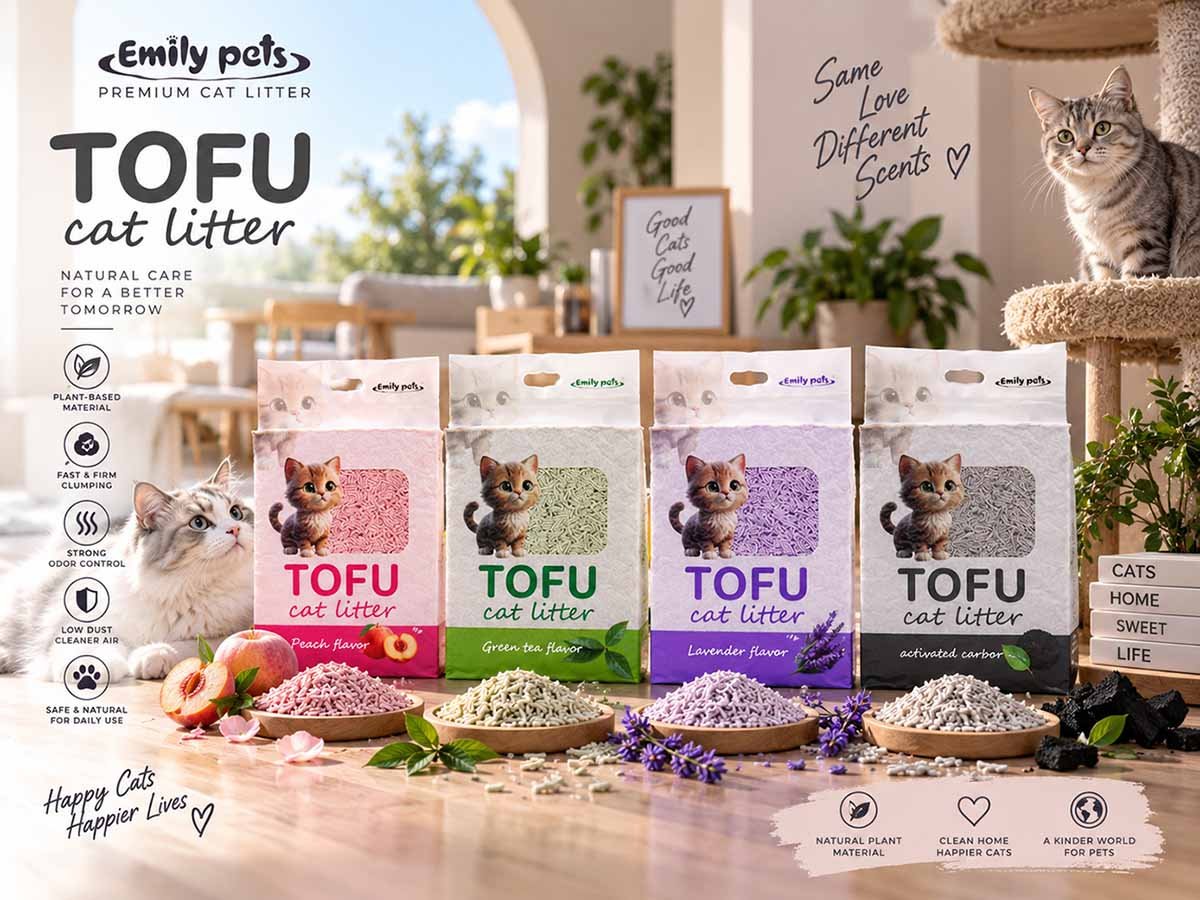
Raw material: soybean pulp, starch binder, food-grade colorant and (optional) fragrance. The fastest-growing family in the export market between 2020 and 2025.
The best tofu cat litter brand for any given market is usually the one with the cleanest granulation (round 1.8–2.5 mm) and the most stable colour batch-to-batch. Tofu is unforgiving on QC lapses.
Raw material: cassava starch, cassava fiber, plant binder.
Cassava sits between tofu and pine in feel and price. It is often the best plant-based option for markets that want eco without paying the tofu premium.
Raw material: pine wood fiber or pine sawdust, pressed into pellets or shredded granules.
These three do not move the same volume as the main four, but they unlock niche programmes that a pure-play mainstream supplier often cannot serve.
Recycled paper pulp, soft pellets or shreds. Excellent for kittens, post-surgery cats and small pets. Very low dust, soft on paws, weak clumping. Often the safest option for the most vulnerable cats.
Soft wood fiber shaving. Strong natural odor control, not clumping. Common in mixed small-pets programmes (cats + rabbits + ferrets). Aspen variants are softer and lower in phenols than pine.
Finely ground quartz sand used in some Asian markets for its clean white look. Not clumping. Often combined with a deodorizer. Important for programmes that serve markets with cultural attachment to the bathing-sand format.
| Family | Clumping | Weight (kg/L) | Dust | Flushable? | Target market |
|---|---|---|---|---|---|
| Bentonite (clumping) | ★★★★★ | 0.85 – 1.05 | Low – medium | Usually no | Mid / value, traditional |
| Tofu | ★★★★ | 0.45 – 0.55 | Very low | Yes (most) | Eco, apartment, premium |
| Cassava | ★★★ | 0.55 – 0.70 | Low | Limited | Eco mid-market |
| Pine | ★★ | 0.55 – 0.65 | Very low | Small batches | Eco premium, sensitive cats |
| Paper | ★ | 0.40 – 0.50 | Very low | Yes | Kittens, post-surgery |
| Wood / Aspen shaving | ★ | 0.30 – 0.40 | Low | Limited | Small pets, mixed programmes |
| Bathing sand (quartz) | ★ | 1.10 – 1.30 | Medium | No | Traditional Asian markets |
Emily Pet is the full shelf: tofu, bentonite, cassava, pine as the four main formulas, then paper, aspen shaving, bathing sand, wood shaving and cat snack as the secondary catalogue. For a buyer who needs one supplier to fill the entire category section of a retail shelf, Emily Pet is the cleanest entry point.
Cat Global deliberately trims back to tofu, bentonite, cassava and pine. No secondary SKUs. For a buyer who wants tight QC, simpler container math and a tighter price-per-ton negotiation on the four workhorse formulas, Cat Global is the cleaner option.
Love Sand takes the same product families and targets the value channel. Pricing per ton is the lowest in the group, while production still happens on the same lines with the same documentation. Useful when the retail programme needs a price-tier backup to the premium label.
Procurement note. All three PY-PET lines sit on the same 18,000 m² site with shared QC, so the classification above is internally consistent across the group. One supplier means one set of lab numbers, one BSCI / ISO 9001 / SGS pack, one shipping plan.
Tofu and pine. Bentonite still leads in absolute volume but is growing more slowly in mature markets. Cassava is the quiet winner — solid mid-tier growth, especially in South America and the Middle East.
For a wholesale buyer, yes. The four families target different shelf segments and different price tiers. Carrying only one or two limits reach and leaves margin on the table.
Pellet-grade pine and high-purity tofu. Lead times can stretch during peak season (Q3 / Q4) for both. Confirm capacity before you commit the seasonal PO.
接触
Send an inquiry now to get the best price.