Sourcing bulk cat litter from a Chinese manufacturer is a high-volume, low-margin category — and the wrong vendor can quietly erode both. This 7-step framework is what we run through when a new procurement team asks us to evaluate ourselves against a competitor, and it is what we recommend every B2B cat litter buyer use before signing a deposit.
Why bulk cat litter sourcing is uniquely risky
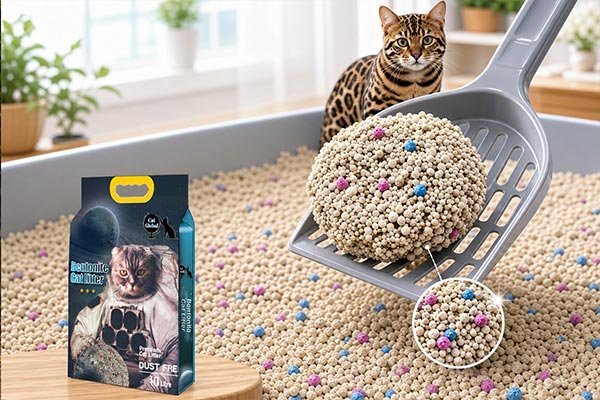
Bulk cat litter is not like a precision-engineered component. The product itself is forgiving — most substrates pass a basic clumping-and-dust test. The risk is hidden in things that surface only after the first container has shipped: dust drift between batches, fragrance drift after three months on a humid shelf, weak clumping strength when the recipe is changed to save $5/ton, and — the worst one — finding out your “manufacturer” is actually a trading company that re-packs whatever they can buy cheap that month.
That is why the vetting framework below front-loads the “is this actually a factory” question, and back-loads the price-and-MOQ question. If a buyer gets the factory-identification step wrong, every other step is wasted.
The 7-step framework
Step 1 — Confirm it is actually a factory, not a trading company
Trigger: Every vendor qualifies as a “cat litter manufacturer” until you ask for the factory license, the production-line count, and the capacity figures. The single biggest red flag is a vendor who refuses to host a video walk-through or sends the same factory video every other trading company does.
What to ask for:
- Business license — should list the legal entity name (e.g., Puyuan (Dalian) Pet Products Co., Ltd.), not a generic trade name.
- Production-line count and floor-space (PY-PET: 12 lines, 18,000 m²).
- Monthly + annual capacity figures (PY-PET: 6,000 t/month, 150,000 t/year).
- Live video walk-through of the production floor with date stamp.
- At least 2 customer references — ask the references for the actual product, not the price.
If the vendor can only show you a website, a WeChat, and a catalog PDF, you are probably talking to a trading company. That is not automatically disqualifying, but it changes the contract terms: a trading company cannot give you a 20-day lead time guarantee or a batch-level COA.
Step 2 — Run a 3-sample blind test before the audit log changes
Trigger: Once a factory is confirmed, the next test is whether the substrate recipe is reproducible. Many factories buy raw bentonite or soy residue from a third-party compounder, which means each batch can drift.
What to do:
- Ask for 3 separate 1 kg samples, pulled from 3 different production weeks.
- Run your own dust test (200-mesh sieve), clumping test (200 ml water), and fragrance test (sniff after 24 h sealed in a jar).
- Compare against your existing reference sample. A consistent sample set is the cheapest insurance you can buy — it costs the factory $20 of freight.
PY-PET ships a free 1 kg sample with every new account, and we ship larger 5–10 kg lab samples on request. See the inquiry form.
Step 3 — Structure the trial order to test both quality AND documentation
Trigger: The first small order tests two things: whether the recipe survives shipping, and whether the factory can produce a complete export documentation pack.
Recommended trial structure:
- 2-ton minimum — the smallest container-share quantity that tests real production, not lab bench.
- Ship under the actual destination’s documentation requirements — Health Certificate, Packing List, Commercial Invoice, COA, MSDS, COO.
- Confirm the COA matches the substrate and fragrance on the pack label — a common drift point.
A factory that passes the trial with full documentation is a different vendor from one that asks you to “wait until the bulk order” for paperwork.
Step 4 — Match MOQ to substrate, not to vendor preference
Trigger: Many factories quote a single MOQ for “cat litter” — but the right MOQ depends on substrate density. Tofu cat litter is lighter than bentonite, so a 20-foot container carries fewer tons. A factory quoting 18 MT for “cat litter” is implicitly quoting tofu (or cassava); 26 MT is bentonite.
Reference MOQ figures (PY-PET):
| Substrate | 20FT container (1×20GP) |
|---|---|
| 豆腐猫砂 | ≈ 18 MT |
| ベントナイト製猫砂 | ≈ 26 MT |
| Cassava cat litter | ≈ 18–22 MT |
| 松材の猫砂 | ≈ 18–22 MT |
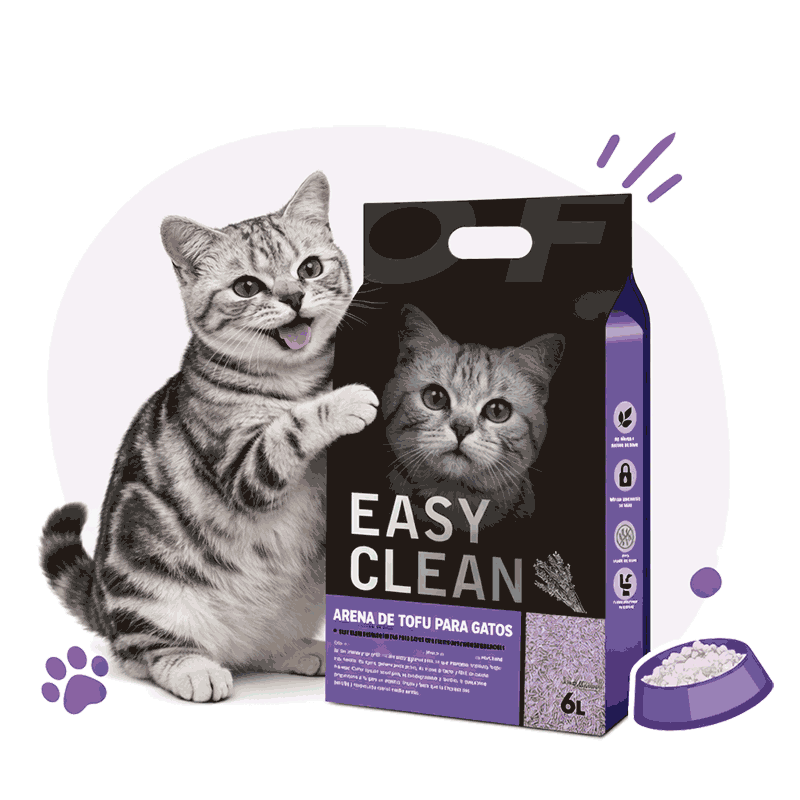
| Paper / aspen / wood shaving / bathing sand | quoted per SKU |
For a side-by-side substrate comparison, see tofu vs cassava cat litter — which substrate fits your market.
Step 5 — Lock the Incoterm before negotiating price
Trigger: Comparing a FOB Dalian quote to a CIF Rotterdam quote without normalising the Incoterm is the single most expensive sourcing mistake. Freight from Dalian to Santos in 2026 is not the same as Dalian to Hamburg.
Incoterm matrix for bulk cat litter:
| Incoterm | What the seller covers | What you cover | Use when |
|---|---|---|---|
| FOB Dalian | factory production + inland freight to port + export clearance | ocean freight + insurance + import clearance + last-mile | you control your freight spend (typical for chain-store buyers) |
| CIF | factory + freight + insurance to destination port | import clearance + duty + last-mile | you want one quote and you have a customs broker |
| DDP | everything — factory to your warehouse | nothing (except VAT/GST) | small first-time buyers who do not yet have a customs broker |
Step 6 — Add 3 contract terms that almost always get missed
Trigger: A standard Proforma Invoice lists product, price, quantity, and Incoterm. It almost never lists the things that go wrong after the container is at sea. These three terms take 10 minutes to negotiate and save $50,000+ of dispute risk.
Add to every bulk cat litter contract:
-
- Batch-level COA requirement — every container ships with a COA tied to its production batch number; buyer can request a re-test at destination at seller’s cost if a parameter is out of spec by ≥ 5 %.
- Lead-time penalty clause — if the seller misses the contractual lead time by ≥ 7 days, a 1 % per-week penalty applies against the deposit.
- Substrate substitution prohibition — the seller cannot substitute substrate (e.g., tofu → soy-residue composite) without written buyer approval. This is the most common silent-quality drift in cat litter.
Step 7 — Plan the repeat-order cadence, not just the first order
Trigger: The first container is a one-off. The relationship is what determines whether your 2nd, 3rd, 4th, and 12th container ship on a known rhythm — or whether each one feels like a new vendor evaluation.
Repeat-order hygiene:
-
-
- Same substrate, same fragrance, same pack size — keeps the recipe stable.
- 20-day cycle target — matches the standard bulk cat litter manufacturer lead time from deposit.
- Single dedicated account manager — eliminates handoff losses between sales / production / export.
- Quarterly COA review — even if no complaint has surfaced, the COA trend tells you whether the recipe is drifting.
-
How PY-PET runs through this 7-step framework
For full transparency — here is how we at PY-PET score on each step of our own framework.
| Step | PY-PET position |
|---|---|
| 1 — Factory confirmation | Puyuan (Dalian) Pet Products Co., Ltd. legal entity; Aisha-Pet factory; 18,000 m²; 12 production lines; live video walk-through on request |
| 2 — 3-sample blind test | Free 1 kg sample + 5–10 kg lab samples on request |
| 3 — Trial order | 2-ton minimum, full export documentation pack, 20-day lead time |
| 4 — MOQ by substrate | Tofu 18 MT · bentonite 26 MT · cassava 18–22 MT · pine wood 18–22 MT per 20GP |
| 5 — Incoterm | FOB Dalian standard · CIF / DDP quoted per lane |
| 6 — Contract terms | Batch-level COA · 20-day lead time penalty · no substrate substitution without approval |
| 7 — Repeat-order cadence | Dedicated account manager · 20-day cycle target · quarterly COA trend review |